A fern is a seedless vascular plant that reproduces through spores. Most familiar ferns have roots, a stem called a rhizome and leaves called fronds. They do not produce flowers, fruits or seeds, and their life cycle alternates between a large sporophyte and a much smaller gametophyte.
What Is a Fern?
A fern is a member of an ancient lineage of vascular plants that disperses through spores rather than seeds. “Vascular” means that the plant contains specialized tissues for moving water, minerals and sugars through its body. In most familiar species, the visible fern consists of roots, a stem or rhizome and one or more leaves known as fronds.
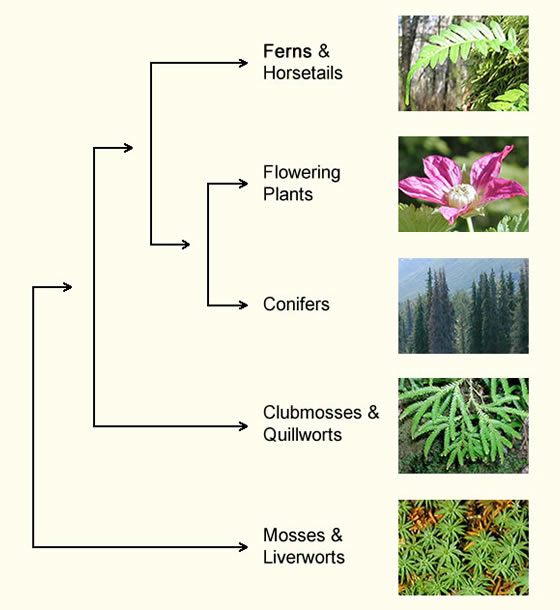
The scientific boundaries of the fern lineage are broader than the everyday image of a leafy woodland plant. A widely used modern classification, PPG I, places living ferns in the class Polypodiopsida and recognizes four major subclasses. In this broad evolutionary sense, the fern lineage includes horsetails, whisk ferns, adder’s-tongues and moonworts, marattioid ferns and the large group containing most familiar leafy ferns.[1]
That does not mean every member looks like a Boston fern. Horsetails have jointed stems and tiny leaves, while whisk ferns have greatly reduced leaflike structures. In ordinary horticultural and field-guide language, “fern” is most often used for plants with recognizable fronds. The broader scientific classification reflects evolutionary relationships, not just outward appearance.
The total depends on the classification and date used. PPG I estimated about 10,578 living fern species in 2016. A 2022 Fern Tree of Life reference taxonomy contained 12,237 accepted species in 350 genera, 48 families and 11 orders. These figures should be presented as dated estimates, not as a permanent exact total.[1][2]
Key Characteristics of Ferns
Ferns are extremely diverse, so no single leaf shape, size or habitat describes all of them. Some have delicate divided fronds, while others have broad, undivided leaves. Some grow as tiny plants on rocks or tree trunks; others develop trunks and crowns of large fronds. Aquatic ferns float or root in wetlands, and drought-adapted species survive in exposed rock crevices.
Despite that variety, the fern lineage is generally recognized by a combination of characteristics:
- Ferns are vascular plants with water- and food-conducting tissues.
- They do not produce flowers, fruits or seeds.
- They form spores inside structures called sporangia.
- The large, familiar plant is the sporophyte generation.
- The life cycle also includes a smaller gametophyte generation.
- Sexual fertilization generally requires a thin film of water through which sperm can move.
- Most familiar ferns have fronds that emerge from a rhizome.
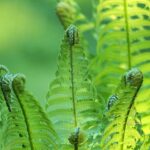
- Many young fronds emerge curled and gradually unroll as fiddleheads.
Are Ferns Vascular Plants?
Yes. Ferns are vascular plants, meaning they possess specialized transport tissues. Xylem conducts water and dissolved minerals through the plant, while phloem distributes sugars and other products of photosynthesis.
Vascular tissue helps distinguish ferns from mosses, liverworts and hornworts, which are nonvascular plants. It allows many ferns to develop larger and more structurally complex bodies than most mosses. Ferns also have an organized root-and-shoot system, although a few unusual lineages have highly modified structures.
Being vascular does not mean that a fern reproduces like a flowering plant. Ferns have conducting tissues but remain seedless. Their spores give rise to a separate gametophyte before fertilization produces the next leafy sporophyte.
Do Ferns Have Flowers or Seeds?
Ferns do not have flowers, fruits or seeds. The brown dots, lines or patches seen on many fern fronds are not seeds and are not usually a disease. They are often sori: groups of spore-producing sporangia.
A spore is not a miniature seed. A seed contains a multicellular plant embryo, stored nutrition and a protective covering. A fern spore is usually a single reproductive cell with a much simpler structure. When conditions are suitable, the spore germinates into a gametophyte rather than directly becoming a mature leafy fern.
For a more focused explanation, see Do Ferns Have Seeds? and the complete fern spore guide.
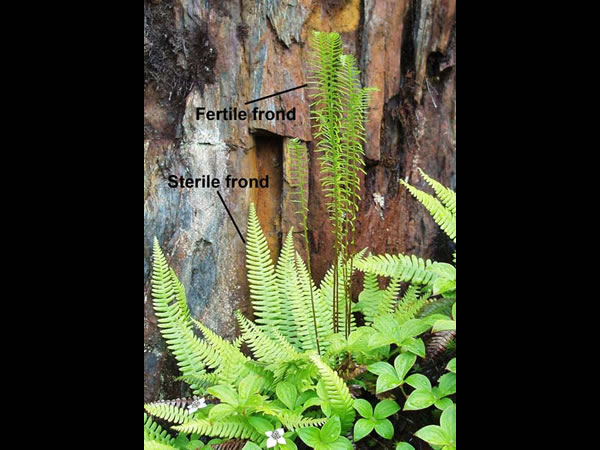
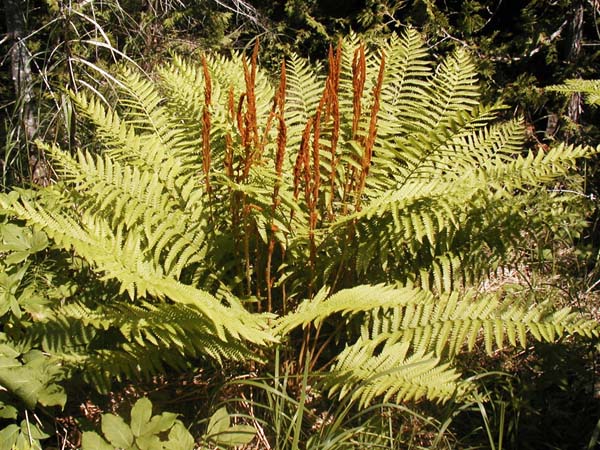
Regular rows or clusters of brown structures are often normal sori containing sporangia. Their shape and position can help identify a fern. However, not every fern places sori on the underside of an ordinary green frond, and not every brown mark is reproductive tissue. Some species use frond margins or separate fertile fronds.
| Feature | Ferns | Flowering plants |
|---|---|---|
| Vascular tissue | Present | Present |
| Flowers | Absent | Present as reproductive structures |
| Seeds | Absent | Present |
| Fruits | Absent | Develop from the ovary after fertilization |
| Main dispersal structure | Spores in most species | Seeds, sometimes enclosed in fruits |
| Gametophyte | Usually a separate, free-living or independently growing stage | Highly reduced and retained within reproductive structures |
| Need for free water during fertilization | Generally yes | No; pollen transfers the male gametophyte |
Parts of a Fern
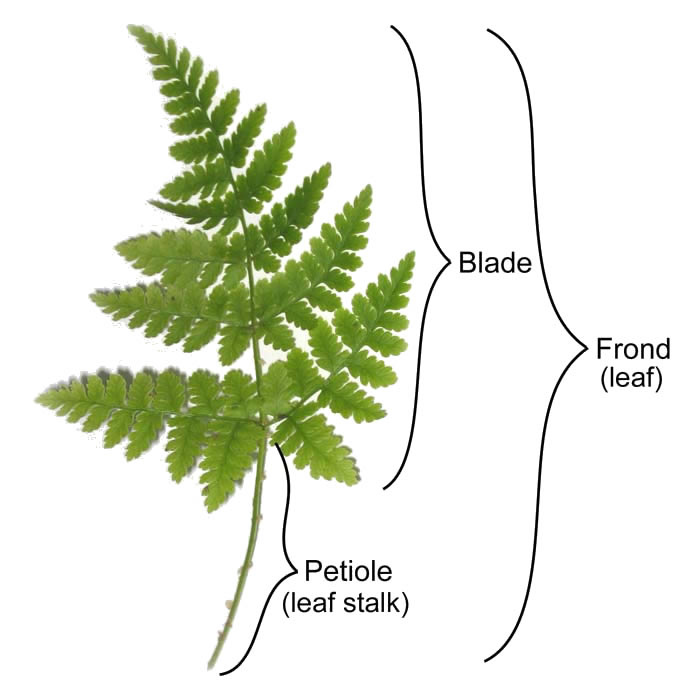
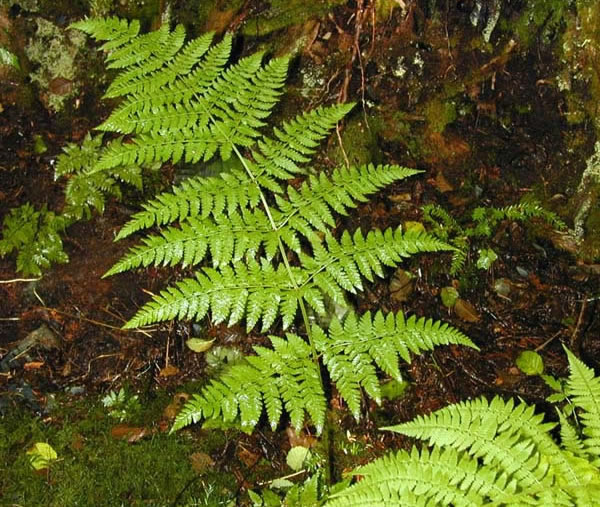
Fern anatomy is easiest to understand by separating the leaf, stem, roots and reproductive structures. The terminology below describes a typical divided fern frond, but not every species has every visible division. A hart’s-tongue fern, for example, has a simple, undivided blade.
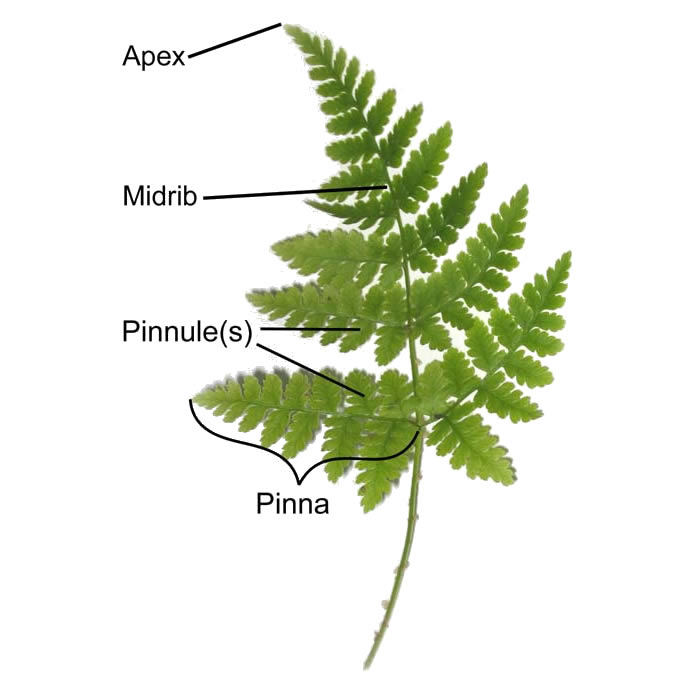
| Fern part | Plain-English definition | Important note |
|---|---|---|
| Frond | The complete fern leaf, including its stalk and blade. | Fronds may be simple, lobed, once divided or divided several times. |
| Blade or lamina | The expanded leafy portion of the frond. | It begins above the stipe and may be divided into pinnae. |
| Stipe | The stalk below the leafy blade. | It connects the blade to the rhizome. |
| Rachis | The main axis running through the divided blade. | Pinnae are attached along the rachis. |
| Pinna | One primary division or leaflet of a divided frond. | The plural is pinnae. |
| Pinnule | A smaller division of a pinna. | Present only in fronds divided more than once. |
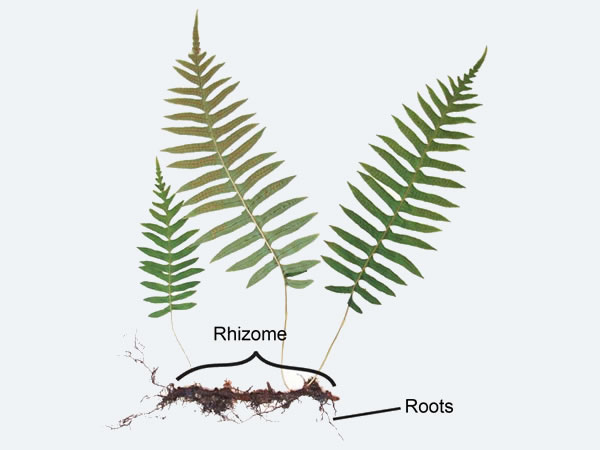
| Rhizome | The fern’s stem, often growing horizontally at or below the surface. | Fronds and roots grow from the rhizome. |
| Roots | Structures that anchor the fern and absorb water and minerals. | Roots commonly arise from the rhizome. |
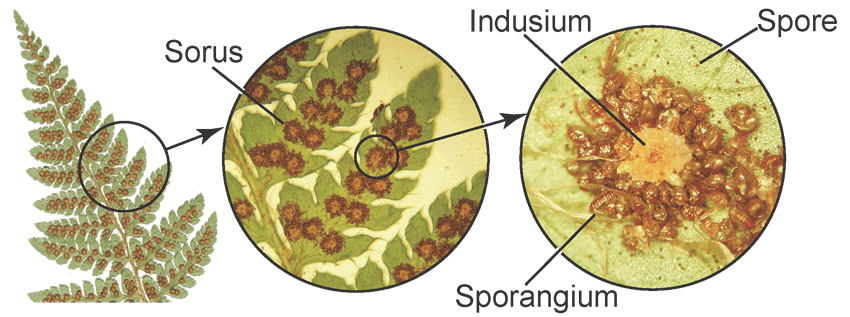
| Sorus | A cluster of sporangia. | The plural is sori. |
| Sporangium | A structure in which spores develop. | Many sporangia may be grouped in one sorus. |
| Indusium | A protective flap or covering over a young sorus. | Some species have indusia; others do not. |
Frond
The complete fern leaf is called a frond. It performs photosynthesis and, when fertile, may also bear sporangia. Some species produce fronds that perform both functions. Others are dimorphic, meaning their fertile and sterile fronds differ in shape or appearance.
Stipe and rachis
The stipe is the lower leaf stalk between the rhizome and the blade. Once the stalk enters the leafy blade of a divided frond, its continuing central axis is called the rachis. Scales, hairs, grooves and color on the stipe and rachis can be useful identification features.
Pinnae and pinnules
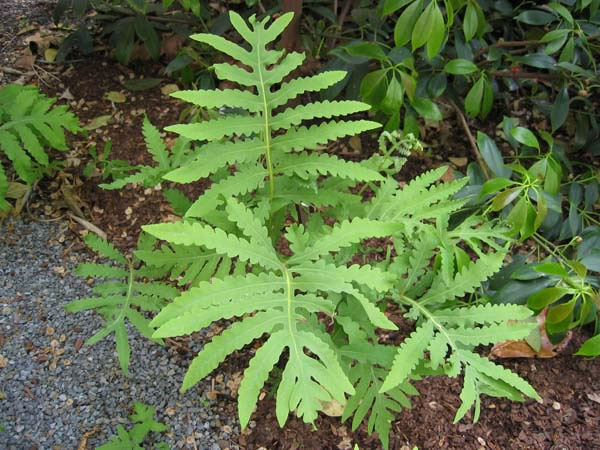
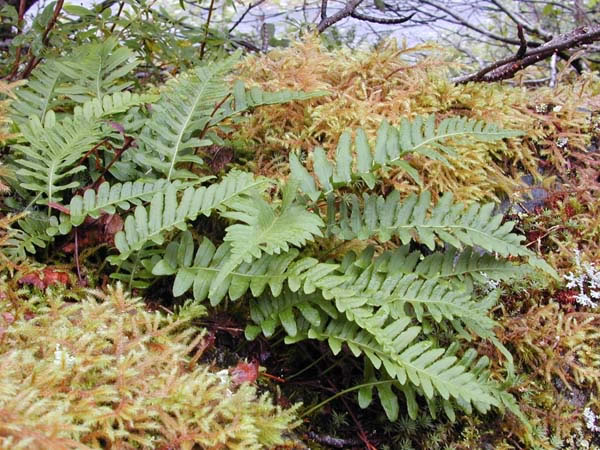
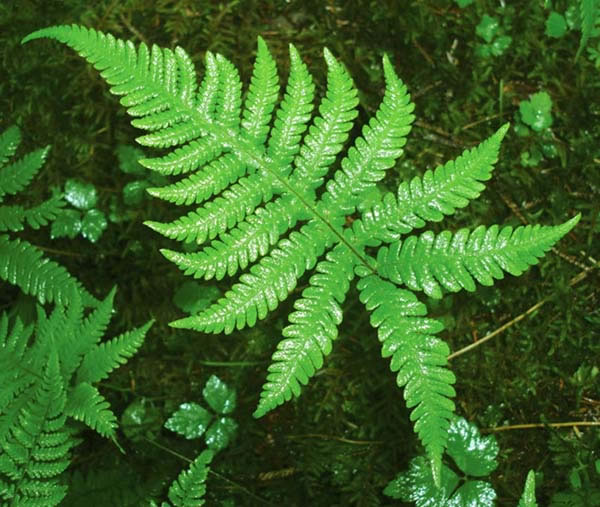
A pinna is one primary division of a divided frond. If each pinna is divided again, the smaller units are pinnules. Botanists describe the degree of division with terms such as pinnate, bipinnate and tripinnate. These words describe structure rather than separate fern groups.
Rhizome and roots
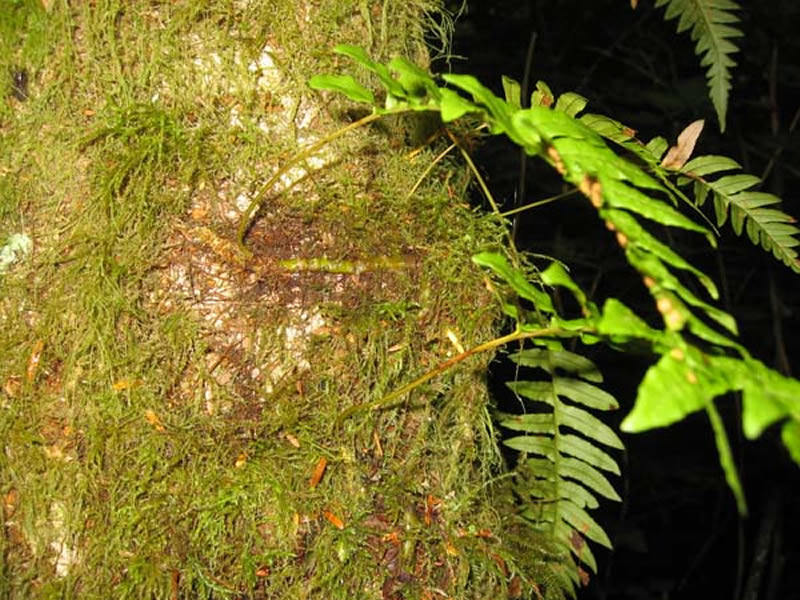
A rhizome is a stem, not a root. Depending on the species, it may be erect, short-creeping or long-creeping. An erect or compact rhizome can produce a crown of closely grouped fronds. A long-creeping rhizome may produce widely spaced fronds and gradually form a colony.
True roots usually emerge from the rhizome. They absorb water and minerals and help anchor the plant in soil, moss, bark, rock crevices or other substrates.
Sori and sporangia
Sporangia are the structures in which spores form. In many familiar ferns, groups of sporangia form visible sori on a fertile frond. A sorus may be round, elongated, marginal or arranged in lines. Some young sori are protected by an indusium.
Sori are commonly found on the lower surface of fronds, but that position is not universal. Some ferns bear sporangia near the leaf margin, on modified portions of a frond or on separate fertile fronds.
How Ferns Reproduce
Fern reproduction involves alternation of generations. This means the life cycle moves between a diploid sporophyte, which produces spores, and a haploid gametophyte, which produces eggs and sperm.
The leafy plant recognized as a fern is the sporophyte. Sporangia on a fertile sporophyte produce haploid spores through meiosis. A spore that reaches a suitable location may germinate and grow into a gametophyte.
In many common homosporous ferns, the gametophyte is a small, thin, green structure often described as heart-shaped. This familiar shape is not universal. Gametophytes in some lineages are irregular, ribbonlike, long-lived, subterranean or dependent on fungi.
Reproductive organs form on the gametophyte. Sperm generally require a film of water to swim to an egg. After fertilization, the resulting diploid zygote develops into a young sporophyte. The first fronds and roots grow while the young sporophyte is initially attached to the gametophyte.[6][7]
Ferns can also reproduce vegetatively. Creeping rhizomes may branch or separate, and some species form plantlets, buds or bulblets. Gardeners commonly use division because it is usually faster than raising plants from spores. See how to divide ferns and the broader fern propagation guide.
Simple Fern Life Cycle
Sporophyte vs. gametophyte
| Generation | What it is | What it produces | What it usually looks like |
|---|---|---|---|
| Sporophyte | The diploid generation with two chromosome sets | Spores through meiosis | The familiar fern with fronds, rhizome and roots |
| Gametophyte | The haploid generation with one chromosome set | Eggs and sperm | Often a small green thallus, but form varies among fern groups |
Where Do Ferns Grow?
Ferns occur in tropical, subtropical and temperate regions and occupy far more than damp forest floors. Their distribution includes cloud forests, lowland rainforests, temperate woodlands, wetlands, stream margins, cliffs, limestone crevices, volcanic ground, tree canopies and aquatic habitats.
Moisture is especially important during the gametophyte and fertilization stages, but mature sporophytes differ greatly in their water requirements. Many species favor humid, sheltered environments. Others survive seasonal drought by losing fronds, curling their leaves, entering dormancy or growing in protected rock fissures.
Common fern growth settings include:
- Terrestrial: rooted in soil or forest litter.
- Epiphytic: growing on another plant for physical support without obtaining food as a parasite.
- Lithophytic: growing on rocks or in rock crevices.
- Aquatic or semiaquatic: floating, submerged or rooted in wet soil.
- Climbing: using elongated fronds or stems to rise through surrounding vegetation.
Humid tropical regions contain particularly high fern diversity, including many canopy-dwelling epiphytes. To explore geography and environmental patterns in more detail, visit Ferns: Distribution and Habitat.
Major Types of Ferns
“Types of ferns” can refer either to scientific evolutionary groups or to practical growth forms. These two systems should not be confused.
Major botanical groups
- Leptosporangiate ferns: The overwhelmingly diverse group containing most familiar ferns, including polypodies, maidenhairs, Boston ferns, water ferns and tree ferns. Their sporangia generally develop from a single initial cell.
- Marattioid ferns: Mostly tropical ferns with large, fleshy rhizomes and eusporangiate sporangia that develop from several initial cells.
- Ophioglossoid and whisk-fern lineages: A group containing adder’s-tongues, moonworts, grape ferns and whisk ferns. Their appearance and belowground biology can differ substantially from familiar leafy ferns.
- Horsetails: Jointed, spore-producing vascular plants in the genus Equisetum. Modern broad fern classifications place them within the fern lineage even though they do not have typical broad fronds.
Common growth forms
- Terrestrial ferns grow primarily in soil.
- Epiphytic ferns grow on trunks, branches or other plants for support.
- Tree ferns develop an upright trunklike stem topped by a crown of fronds.
- Filmy ferns often have exceptionally thin fronds and depend on humid microhabitats.
- Water ferns live in aquatic or seasonally flooded habitats.
- Rock ferns occupy cliffs, walls, boulders or mineral-rich crevices.
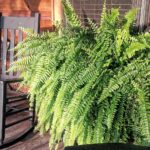
For examples and identification-oriented groupings, see the complete types of ferns guide. Two widely grown houseplant examples are the Boston fern and maidenhair fern, but their care requirements should not be generalized to every fern species.
True Ferns and Fern-Like Plants
The phrase “true fern” is used inconsistently. In many field and horticultural contexts, it refers to the leafy leptosporangiate ferns that make up most living fern diversity. It should not be used to imply that horsetails or other members of the broader fern lineage are evolutionarily unrelated.
Common names can also be misleading. Asparagus fern is a flowering seed plant related to asparagus, not a fern. Clubmosses and spikemosses are seedless vascular plants, but they belong to the lycophyte lineage rather than the fern lineage. “Fern-like” appearance alone is therefore not enough to classify a plant.
“Fern allies” is an older convenience term, not a single natural evolutionary group. Clubmosses, spikemosses and quillworts are lycophytes. Horsetails and whisk ferns are placed within the broader fern lineage by modern phylogenetic classifications. Use the older phrase only when discussing historical classification.
Ferns vs. mosses
| Feature | Ferns | Mosses |
|---|---|---|
| Vascular tissue | Present | Absent |
| True roots | Usually present | Absent; mosses have rhizoids |
| Dominant generation | Sporophyte | Gametophyte |
| Visible leafy plant | Usually the diploid sporophyte | The haploid gametophyte |
| Sporophyte independence | Develops into an independent plant | Remains attached to and nutritionally dependent on the gametophyte |
| Reproduction | Spores; fertilization generally requires surface water | Spores; fertilization also generally requires surface water |
| Typical size | Ranges from tiny plants to large tree ferns | Usually relatively small and low-growing |
Ferns vs. horsetails and clubmosses
Horsetails are included within the broad fern clade in PPG I. Their living species belong to the genus Equisetum and are recognized by jointed, often ridged stems, whorled branches and terminal spore-bearing cones.
Clubmosses, spikemosses and quillworts belong to the lycophyte lineage. They diverged separately near the base of vascular-plant evolution and are not part of Polypodiopsida. The name “clubmoss” is also misleading because clubmosses are vascular plants, not true mosses.
How Old Are Ferns?
Ferns are an ancient lineage, but statements such as “modern ferns are unchanged since the dinosaurs” are inaccurate. Fern history includes many extinct groups, repeated diversification and the evolution of relatively young living lineages.
A large molecular study published in 2016 inferred a mid-to-late Silurian origin for the broad fern lineage, including horsetails, and an early Carboniferous origin for leptosporangiate ferns. The same research found that many derived families arose later and underwent substantial diversification during the Cretaceous and Cenozoic.[3]
Evolutionary dates depend on fossil calibration, taxon sampling and analytical methods. They are estimates with uncertainty, not exact birthdays for the first fern.
Why Ferns Matter Ecologically
Ferns are not simply decorative plants beneath trees. In many ecosystems they contribute to understory structure, ground cover, litter production, nutrient movement and the physical conditions experienced by smaller organisms.
Dense fern cover can shade soil, reduce surface exposure and provide shelter for invertebrates and other organisms. Epiphytic ferns contribute to the biological complexity of forest canopies, where mats of roots, rhizomes and accumulated organic material can retain water and nutrients and provide habitat.
Ferns can also influence recovery after disturbance. A 2024 synthesis proposed that fern communities may facilitate ecosystem recovery by stabilizing substrates, improving some soil properties and modifying competition as plant communities reassemble. The effect is species- and habitat-dependent: some ferns support recovery, while aggressive species can also dominate disturbed land.[9]
Their ecological roles include:
- forming part of forest understory and ground-layer vegetation;
- providing food, cover or microhabitats for animals and microorganisms;
- contributing organic matter through dead fronds and roots;
- occupying exposed, wet, rocky or canopy habitats unavailable to many larger plants;
- participating in primary succession and post-disturbance recovery in some ecosystems;
- increasing structural diversity in tropical and temperate forests.
Do All Ferns Need the Same Care?
No. Ferns share a broad evolutionary history, but they do not all require deep shade, constant humidity or permanently wet soil. A tropical epiphyte, a temperate woodland fern and a drought-adapted rock fern can have very different environmental requirements.
This page explains fern biology rather than providing a complete growing tutorial. For practical cultivation guidance, continue with:
Frequently Asked Questions
What is the simplest definition of a fern?
A fern is a seedless vascular plant that produces spores and has alternating sporophyte and gametophyte generations.
Are ferns flowering plants?
No. Ferns are vascular plants, but they do not form flowers, fruits or seeds. Their reproductive cycle uses spores and a separate gametophyte generation.
Are the brown dots under fern leaves seeds?
Usually not. Regular brown dots or lines are often sori, which contain spore-producing sporangia. Ferns do not produce seeds.
Is a fern spore the same as a seed?
No. A seed contains an embryo, stored resources and a protective coat. A fern spore is usually a single reproductive cell that grows into a gametophyte.
Why do ferns need water to reproduce?
Fern sperm are motile and generally need a thin film of water to reach an egg on the gametophyte. The mature sporophyte may tolerate drier conditions than the reproductive stage.
Are horsetails ferns?
In modern broad phylogenetic classifications such as PPG I, horsetails are included within Polypodiopsida, the fern lineage. They remain visually and anatomically distinct from familiar leafy ferns.
Are clubmosses ferns?
No. Clubmosses are seedless vascular plants in the lycophyte lineage. They are evolutionarily separate from ferns and are not true mosses.
Do all ferns have divided leaves?
No. Some ferns have highly divided, lacy fronds, but others have simple, strap-shaped or otherwise undivided blades.
Do all ferns have sori under their leaves?
No. Many do, but sporangia may also occur along margins, on modified leaf sections or on separate fertile fronds. Sorus shape and position vary among groups.
Can ferns reproduce without spores?
Fern sexual reproduction involves spores, but many species can also spread vegetatively through rhizomes, divisions, plantlets, bulblets or buds.
Fern Glossary
- Blade
- The expanded leafy portion of a frond; also called the lamina.
- Fiddlehead
- A young, curled fern frond before or while it is unrolling.
- Frond
- The complete fern leaf, including the stipe and blade.
- Gametophyte
- The haploid life-cycle generation that produces eggs and sperm.
- Indusium
- A protective covering over a developing sorus in species that possess one.
- Lamina
- Another term for the blade or expanded portion of a fern leaf.
- Meiosis
- Cell division that reduces the chromosome number and produces haploid spores.
- Pinna
- One primary leaflet or division of a divided frond; plural: pinnae.
- Pinnule
- A smaller subdivision of a pinna in a more finely divided frond.
- Rachis
- The main central axis running through the blade of a divided frond.
- Rhizome
- The fern’s stem, which may be upright, creeping, underground or surface-growing.
- Sorus
- A cluster of sporangia; plural: sori.
- Spore
- A reproductive cell capable of growing into a gametophyte without first fusing with another cell.
- Sporangium
- A structure in which spores are formed; plural: sporangia.
- Sporophyte
- The diploid spore-producing generation and the stage normally recognized as a fern.
- Stipe
- The stalk between the rhizome and the beginning of the leafy blade.
- Vascular tissue
- Xylem and phloem that conduct water, minerals, sugars and other materials through a plant.
Continue Exploring Ferns
References
- Pteridophyte Phylogeny Group I. 2016. “A Community-Derived Classification for Extant Lycophytes and Ferns.” Journal of Systematics and Evolution 54(6): 563–603. DOI: 10.1111/jse.12229
- Nitta, J. H., Schuettpelz, E., Ramírez-Barahona, S., and Iwasaki, W. 2022. “An Open and Continuously Updated Fern Tree of Life.” Frontiers in Plant Science 13: 909768. DOI: 10.3389/fpls.2022.909768
- Testo, W., and Sundue, M. 2016. “A 4000-Species Dataset Provides New Insight into the Evolution of Ferns.” Molecular Phylogenetics and Evolution 105: 200–211. DOI: 10.1016/j.ympev.2016.09.003
- Royal Botanic Gardens, Kew. Plants of the World Online. Nomenclatural, taxonomic and distribution information for vascular plants. Plants of the World Online
- U.S. Forest Service. “What Are Ferns?” Celebrating Wildflowers. USFS fern overview
- U.S. Forest Service. “Fern Structure” and “Fern Reproduction.” Celebrating Wildflowers. Fern structure; fern reproduction
- Natural History Museum, London. “Unfurl the Secrets of Ferns.” Natural History Museum fern guide
- Iowa State University Extension and Outreach. “Growing Ferns in Iowa.” Last reviewed May 2025. Iowa State fern anatomy and life cycle
- Azevedo-Schmidt, L., et al. 2024. “Ferns as Facilitators of Community Recovery Following Biotic Upheaval.” BioScience 74(5): 322–335. BioScience article
- Krömer, T., et al. 2025. “Impact of Land-Use Change on Vascular Epiphytes: A Review.” Plants. Review on vascular epiphytes