
Quick Answer
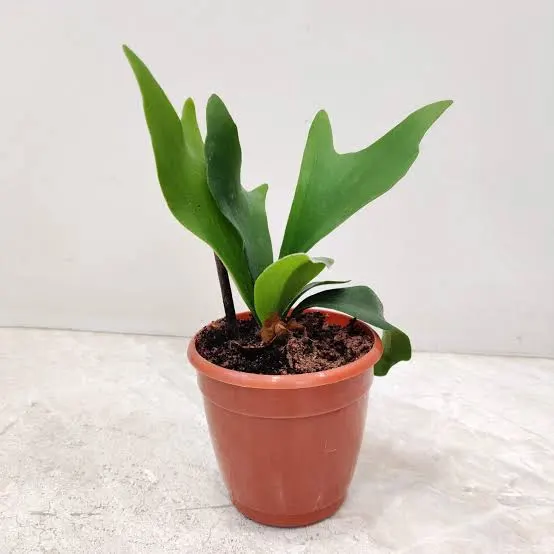
The staghorn fern most often sold as a houseplant is Platycerium bifurcatum, an epiphytic fern that naturally grows attached to trees rather than rooted in forest soil. Give it bright, filtered light, moving air and a mount or medium that can become partly dry after being thoroughly watered.
Water based on the condition of the moss, root zone and mount—not on a fixed weekly schedule. Saturate the root area by soaking or flushing it, then allow all excess water to drain. Brown, papery shield fronds are normally retained because they protect the rhizome and roots.
Staghorn Fern at a Glance
Which Staghorn Fern Does This Guide Cover?
“Staghorn fern” is a common name applied to multiple species in the genus Platycerium. This guide focuses on Platycerium bifurcatum, the species most frequently grown in homes and commonly described by university horticulture sources as one of the easier staghorn ferns to cultivate.
Plants of the World Online accepts the name Platycerium bifurcatum (Cav.) C.Chr. and records its native range from Java to New Caledonia. The species occurs across a broad area that includes New Guinea and eastern Australia and is now cultivated far beyond its native range.
As checked in July 2026, Kew’s Plants of the World Online lists 17 accepted species entries under Platycerium. Taxonomic databases are revised as evidence and treatments change, so this number should always be read with its source and access date.
Different Platycerium Species Need Different Care
Do not automatically apply this entire guide to every plant labeled “staghorn fern.”
- P. bifurcatum: commonly forms colonies and may produce removable pups as its short rhizomes branch.
- P. veitchii: is slower-growing, notably silver-blue and generally more tolerant of brighter, drier conditions.
- P. superbum: develops a large, upright litter-catching nest and is generally treated as a solitary, non-offsetting species rather than a pup-forming colony.
Size, temperature tolerance, preferred light, seasonal moisture and propagation method can differ substantially. Identify the scientific name before changing an established plant’s care.
How Staghorn Ferns Grow
A staghorn fern is an epiphyte. In nature, it attaches to a tree trunk or branch for physical support, but it is not a parasite and does not feed by extracting sap or nutrients from the host tree.
Its roots anchor the plant and absorb water from the material collected around its base. Overlapping basal fronds help trap rain, fallen leaves and other organic debris. As that debris breaks down, it contributes to the small pocket of organic material surrounding the plant.
This growth habit explains why a staghorn fern should not be treated as an ordinary terrestrial fern planted deeply in dense, moisture-retentive potting soil. Its root zone needs both moisture and oxygen.
For a broader introduction to fern structure and reproduction, see What Are Ferns?.
Shield Fronds vs. Antler Fronds
| Frond type | Appearance | Primary functions | What happens with age |
|---|---|---|---|
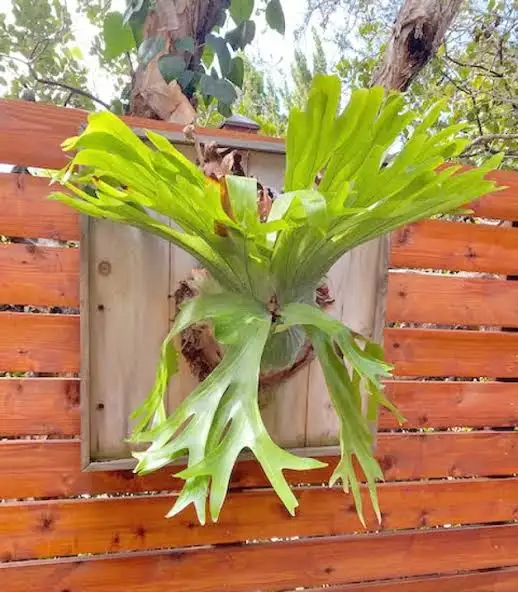
| Basal, shield or sterile fronds | Rounded, heart-shaped or shield-like fronds pressed against the mounting surface and overlapping around the plant’s base. | Protect the rhizome and roots, help secure the plant and trap water and organic debris. | Begin green and gradually mature to tan or cinnamon-brown, becoming dry and papery. |
| Fertile, foliar or antler fronds | Outward-growing, gray-green fronds divided into forked, antler-like segments. | Photosynthesis and spore production. | May develop brown spore-producing areas underneath and eventually age, decline and dry like other fern fronds. |
Are Brown Shield Fronds Normal?
Yes. A green shield frond normally matures into a dry, papery brown layer. This color change alone is not evidence of rot, underwatering or disease. Older shields remain useful because they cover and protect the root crown, rhizome and accumulated organic material.
Do not cut away an intact shield merely because it has turned brown. New shields commonly grow over older ones, gradually creating several protective layers.
| Brown and usually normal | Brown and potentially concerning |
|---|---|
| Dry, papery tan or cinnamon shield fronds | Black, soft, wet or foul-smelling tissue around the crown |
| Brown spore patches in organized areas beneath mature fertile fronds | Irregular water-soaked lesions that continue spreading |
| One older fertile frond drying as the plant produces new growth | Several fertile fronds collapsing suddenly |
| Minor cosmetic browning on an old frond | Rapid crisping after intense sun, extreme drying or a cold exposure |
Mounting, Baskets and Containers
P. bifurcatum can be grown on a board, in a hanging basket or in an exceptionally airy container. The best method depends on plant size, your climate and how easily you can inspect and water the root zone.
| Method | Advantages | Limitations | Best suited to |
|---|---|---|---|
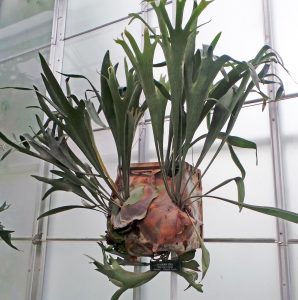
| Mounted on wood or cork | Excellent aeration, natural presentation and easy drainage. | May dry quickly; watering can be inconvenient; mature plants become heavy. | Established plants in bright indoor spaces or sheltered outdoor locations. |
| Hanging basket | Holds more growing material and provides room for a clumping plant to spread around the basket. | Retains moisture longer and can become extremely large and heavy. | Vigorous, pup-forming P. bifurcatum colonies. |
| Airy container | Easier to place, move and water while the plant is small. | Dense mixes stay wet too long; a normal pot can restrict the plant’s natural spreading habit. | Juvenile or recently separated plants in a coarse epiphytic medium. |
Choosing a Support
Use untreated wood, cork bark or another stable material able to support both the wet mount and the plant’s future weight. Choose a support larger than the current root mass so the shield fronds have room to expand. Install a strong hanger before mounting the plant.
Sphagnum moss is commonly used around the roots because it holds moisture while remaining relatively airy. A coarse epiphytic or orchid-type medium may also be used in baskets or containers. Avoid compact garden soil and fine mixes that remain continuously saturated.
How to Mount a Staghorn Fern
- Prepare the support. Use a sturdy board, cork slab or similar support with a secure hanger. Check that it can carry the plant after the moss has been saturated.
- Moisten the mounting material. Wet the sphagnum or epiphytic medium, then squeeze out excess water so it is evenly moist rather than dripping.
- Position the root mass. Place a mound of material on the support and set the fern against it. Keep the growing point unobstructed and orient the plant so future fertile fronds can extend freely.
- Secure the root area. Use broad, soft ties such as strips of nylon stocking or another material that will not cut into the plant. Fasten over the root pad or old brown shields—not across a soft green shield, growing point or fertile frond.
- Check for pressure points. The plant should not move freely, but the ties should not crush the crown. Avoid narrow wire or monofilament positioned where expanding tissue could be girdled.
- Water and drain. Thoroughly wet the root zone and moss, then allow the mount to drain before hanging it against an interior wall.
How to Water a Mounted Staghorn Fern
There is no universally correct schedule for staghorn fern watering. A small mount in a warm, bright room may dry much faster than a large basket filled with moss in a cool, humid space.
Check the root zone rather than relying only on the visible brown shields. Lift the mount to learn its wet and dry weights, feel accessible moss near the edge, and consider recent temperature, airflow and light.
When watering is needed, thoroughly soak or flush the moss and root zone. Water should reach the material beneath the basal fronds rather than merely wetting the tips of the antler fronds. Let the plant drain fully before rehanging it.
A fixed immersion time is unnecessary. A compact, mature shield mass, a loose new mount and a deep basket will saturate at different rates. The goal is complete hydration followed by oxygen returning to the root zone as excess water drains and the medium partly dries.
Watering Decision Table
| What you observe | Likely meaning | What to do |
|---|---|---|
| Mount feels much lighter and accessible moss is approaching dry | The root zone is likely ready for water | Soak or flush thoroughly, then drain |
| Moss remains cool and damp beneath the surface | Moisture is still available | Wait and check again later |
| Hot weather, stronger light or persistent airflow | The mount may dry faster | Inspect more often rather than automatically watering |
| Cool, cloudy weather or a large moss-filled basket | Drying may be slower | Extend the interval and verify the center is not staying wet |
| Soft black tissue, sour odor or a constantly saturated base | Possible root or crown decay | Stop routine watering and inspect drainage and damaged tissue |
| Fronds wilt and recover promptly after thorough watering | The plant may have dried too far | Begin checking the mount slightly earlier next time |
See How Often Should I Water a Fern? for additional guidance on evaluating moisture without following a calendar.
Light
Place P. bifurcatum in bright indirect or filtered light. Suitable positions include an east-facing window, filtered light near a brighter window, or a sheltered outdoor location beneath a porch or open tree canopy.
Very low light slows drying and weakens growth, increasing the risk that a moss-filled mount remains wet for too long. Strong, unfiltered sunlight can bleach or scorch fronds, particularly when a plant is moved outdoors without gradual acclimation.
Read Do Ferns Need Direct Sunlight? for a more detailed explanation of window orientation and light stress.
Temperature
Normal warm household conditions suit P. bifurcatum. Protect it from freezing, cold drafts, heating vents and abrupt temperature changes. Although this species is reported to tolerate cooler conditions than many other members of the genus, brief survival during a cold event is not the same as healthy long-term growth.
Do not apply one temperature minimum or one USDA hardiness range to the entire genus. Species differ, and the effect of cold depends on plant age, duration, wind, moisture and acclimation.
Humidity and Air Circulation
Moderate to high humidity reduces rapid moisture loss, but humidity must be paired with air movement and drainage. A stagnant, continuously wet crown is not a healthy substitute for humid air.
In a dry home, use a room humidifier, group plants or select a naturally brighter humid room. Occasional misting can temporarily wet the frond surface, but it does not provide the stable environmental humidity created by a humidifier and does not replace watering the root zone.
Avoid positioning a wet mount directly against a wall. Allow space behind it for drainage and air movement.
Fertilizing
Staghorn ferns can be fed lightly while producing active new growth, but fertilizer should supplement appropriate light and watering rather than compensate for poor conditions.
Use a diluted, balanced houseplant or orchid fertilizer according to its label and the plant’s response. Mounted plants with little growing material have less capacity to buffer fertilizer salts than large baskets. Reduce or stop feeding when growth slows, the plant is stressed or the root zone remains wet.
Periodically water thoroughly without fertilizer so accumulated salts can drain away. Do not place banana peels, food scraps or unmeasured household mixtures behind the shields; they can decompose unpredictably and attract pests.
See Best Soil and Fertilizer for Ferns for more information about epiphytic media and fertilizer salts.
Outdoor Summer Care
A staghorn fern can spend warm weather outdoors in a sheltered location. Introduce it gradually to brighter conditions instead of moving it directly from indoor light into outdoor sun.
Bring the plant back indoors before cold weather creates a risk of chilling or freezing. Local climate information is more useful than assigning every staghorn fern the same hardiness zone.
When to Remount an Established Plant
Remounting may be appropriate when the shield fronds have reached the edge of the board, the support is deteriorating, the hanger is no longer safe or the mature plant’s weight exceeds the original mounting system.
A crowded appearance alone does not always mean the plant must be disturbed. Staghorn ferns naturally develop layered shields and dense colonies. When possible, attach the existing support to a larger, stronger backing rather than stripping away old shields and roots.
Handle a mature plant carefully. Its wet weight may be substantially greater than its dry weight, and old boards, fasteners and hanging wire can fail before the fern itself shows a problem.
Propagation by Pups
Healthy P. bifurcatum plants often produce pups as their short rhizomes branch, but this should not be generalized to every Platycerium species.
Wait until a pup has its own visible growing point, shield frond, fertile fronds and roots. Separating a very small pup without an independent root system greatly reduces its reserves and may damage both the pup and parent.
- Identify the pup’s center and determine where it joins the parent colony.
- Use a clean, sharp blade to separate it with an attached section of roots and rhizome.
- Preserve its shield and fertile fronds instead of reducing it to bare rhizome tissue.
- Mount it on moist, airy material and secure it without covering its growing point.
- Keep conditions stable while it establishes, but do not leave the new root zone waterlogged.
Not every separated pup survives. Division is less appropriate for non-offsetting or solitary species, and an unidentified collector plant should not be cut solely because it has developed multiple shield layers.
Staghorn ferns can also be raised from spores, but this requires clean technique and management of the small gametophyte stage. See Fern Propagation and How to Grow Ferns from Spores.
Common Problems
| Symptom | Possible explanation | What to check first |
|---|---|---|
| Brown shield fronds | Usually normal maturation | Confirm the tissue is dry and papery rather than black, soft or foul-smelling. |
| Brown areas under antler fronds | May be normal spore-producing sori | Look for organized brown patches on mature fertile fronds rather than random spreading lesions. |
| Brown fertile-frond tips | Excess drying, low humidity, fertilizer salts, intense light, chilling or root stress | Check mount moisture, recent environmental changes and whether browning affects old or new growth. |
| Pale, weak or stretched growth | Insufficient light or impaired roots | Evaluate light exposure and whether the medium remains wet too long. |
| Bleached or crisp patches | Sun scorch or abrupt outdoor acclimation | Check whether damage is concentrated on the side facing the strongest light. |
| Black or mushy base | Possible crown or root decay | Inspect drainage, trapped moisture, airflow and damaged tissue. |
| No pups | Plant age, growing conditions or species difference | Confirm the scientific name; not every Platycerium produces offsets. |
Scale and Mealybugs
Scale insects and mealybugs may hide around shield edges, rhizomes and the undersides of fertile fronds. Isolate an affected plant and inspect nearby houseplants.
Do not scrub the protective silver covering from the antler fronds while attempting to remove pests. Where practical, remove isolated insects carefully without abrading the frond. For a larger infestation, use a product legally labeled for the identified pest and the plant’s growing location, following the full label and testing a small area first.
Avoid assuming every brown structure is scale. Normal shield tissue and sori are easily mistaken for pests. See Fern Pests and Diseases for identification guidance.
Rot
Rot is associated with tissue remaining wet under poorly aerated conditions, but a brown shield alone is not rot. Concerning signs include a soft black crown, foul odor, spreading wet tissue and collapse that begins at the base.
Stop following the previous watering routine, improve drainage and airflow, and inspect the mounting material. Remove only tissue that is clearly dead and decomposing, using a clean tool. Do not apply a fungicide automatically; chemical treatment should be based on a plausible diagnosis and a product labeled for the situation.
Browning Fertile Fronds
Individual antler fronds eventually age and can be removed after they are fully dry. Widespread browning of several fertile fronds requires a broader assessment of light, root-zone moisture, fertilizer salts, temperature and recent handling.
See Why Is My Fern Turning Brown? for a fuller comparison of brown tips, patches and dying fronds.
FAQ
How often should I water a mounted staghorn fern?
Water when the moss and root zone have partly dried and the mount feels noticeably lighter. Season, mount size, material, temperature, light and airflow make a fixed interval unreliable.
Should I remove brown shield fronds?
No. Dry, papery brown shields are normally retained because they protect the roots and rhizome. Remove tissue only when it is clearly decomposing or must be addressed during necessary structural work.
What is the brown material under the antler fronds?
Organized brown areas on the undersides of mature fertile fronds are often spore-producing structures. They are not automatically scale, rot or fungal disease.
Can a staghorn fern grow in a pot?
A small P. bifurcatum can grow in a container filled with a coarse, well-aerated epiphytic medium. Dense ordinary potting soil is unsuitable because it can remain wet and exclude air from the roots.
Does misting replace watering?
No. Misting may briefly wet the frond surface but does not reliably saturate the moss and roots or create stable room humidity.
Are staghorn ferns safe for cats?
The ASPCA lists the common staghorn fern, Platycerium bifurcatum, as non-toxic to cats and dogs. That record applies to the identified species rather than every plant sold under a similar common name. Keep the mount, wire and loose growing material out of a pet’s reach.
References
- Royal Botanic Gardens, Kew — Platycerium, Plants of the World Online . Taxonomy and genus distribution. Accessed July 2026.
- Royal Botanic Gardens, Kew — Platycerium bifurcatum, Plants of the World Online . Accepted name and native range. Accessed July 2026.
- University of Wisconsin–Madison Extension — Staghorn Fern, Platycerium bifurcatum . Frond structure, mounting, watering, pests and propagation.
- University of Florida IFAS — Staghorn Fern . Epiphytic growth, mounting, temperature differences and general culture.
- University of Florida IFAS — Staghorn Fern Mounting Tutorial . Mounting materials, board mounting and basket culture.
- NC State Extension — Platycerium bifurcatum . Epiphytic habit, frond types, growing media and plantlets.
- Royal Horticultural Society — Platycerium bifurcatum . Filtered light, epiphytic cultivation, feeding and propagation.
- ASPCA Animal Poison Control — Common Staghorn Fern . Species-specific cat and dog toxicity listing.