No single answer applies to every plant called a fern. Several true ferns—including Boston fern (Nephrolepis exaltata), common staghorn fern (Platycerium bifurcatum), and rabbit’s foot fern (Davallia spp.)—are listed by the ASPCA as non-toxic to cats. Asparagus fern, however, is not a true fern and is listed as toxic. Always verify the scientific name.
Are True Ferns Toxic to Cats?
It is more accurate to answer this question species by species than to say that every fern is safe or every fern is dangerous. The ASPCA lists several commonly grown true ferns as non-toxic to cats, including Boston fern, common staghorn fern, button fern, sword fern, rabbit’s foot fern, and mother fern.
That does not prove that every fern species in the world has been evaluated. The ASPCA explains that its plant database is a compilation of frequently encountered plants and is not intended to be all-inclusive. A plant should therefore be checked by its scientific name rather than cleared simply because it appears to be a fern.
In botanical terms, true ferns are seedless vascular plants that reproduce through spores rather than flowers and seeds. For a general explanation of fern biology and reproduction, see the Learn About Ferns guide to what ferns are and how they differ from flowering plants.
The ASPCA notes that consuming plant material can cause vomiting or gastrointestinal upset even when the plant is listed as non-toxic. This may result from irritation caused by the material itself rather than from a fern-specific poison.
Why the Name “Fern” Can Be Misleading
Common plant names are informal labels. They can be reused for unrelated plants, vary between nurseries, or refer to several species within the same genus. The word “fern” in a store label therefore does not establish botanical identity or toxicity.
Asparagus fern is the clearest example. It has fine, feathery growth that resembles a fern, but it belongs to the flowering-plant genus Asparagus. Kew’s Plants of the World Online recognizes Asparagus densiflorus as an accepted flowering-plant species, while Boston fern belongs to the true-fern genus Nephrolepis.
The same problem can affect names such as foxtail fern, lace fern, plumosa fern, bird’s nest fern, and staghorn fern. Some refer to a specific plant in one nursery and a different species in another. The scientific name on the label is the safer starting point.
True fern
A plant within a genuine fern lineage, such as Nephrolepis, Platycerium, Davallia, Pellaea, Adiantum, or Asplenium. Its toxicity status must still be checked at the species or database-listed taxonomic level.
Fern-like plant
A plant that resembles a fern or carries “fern” in its common name but is botanically different. Asparagus fern is a flowering plant, not a true fern, and the ASPCA lists the Sprengeri form as toxic to cats.
True Ferns vs. Fern-Like Plants
| Common name | Scientific name | True fern or not | Verified toxicity status | Source | Important identification note |
|---|---|---|---|---|---|
| Boston fern | Nephrolepis exaltata, Boston cultivar | True fern | ASPCA: non-toxic to cats | ASPCA; Kew POWO | The ASPCA uses an older horticultural form of the name. Kew treats N. exaltata var. bostoniensis as a synonym within N. exaltata. |
| Common staghorn fern | Platycerium bifurcatum | True fern | ASPCA: non-toxic to cats | ASPCA | “Staghorn fern” covers multiple Platycerium species. Confirm that the plant is actually P. bifurcatum or another separately verified species. |
| Staghorn fern | Platycerium alcicorne | True fern | ASPCA: non-toxic to cats | ASPCA | This is a separate species from the more commonly sold P. bifurcatum. |
| Rabbit’s foot fern | Davallia spp. | True fern | ASPCA: non-toxic to cats | ASPCA | The name is also used for hare fern, squirrel foot fern, deer foot fern, and ball fern. The ASPCA entry covers Davallia spp. |
| Button fern | Pellaea rotundifolia | True fern | ASPCA: non-toxic to cats | ASPCA | Verify the scientific name. “Button fern” can be used informally for plants other than P. rotundifolia. |
| Sword fern | Nephrolepis biserrata | True fern | ASPCA: non-toxic to cats | ASPCA | “Sword fern” is used for several fern species. This conclusion applies to the ASPCA-listed N. biserrata. |
| Mother fern | Asplenium bulbiferum | True fern | ASPCA: non-toxic to cats | ASPCA | Also called mother spleenwort, parsley fern, or hen and chickens fern. Do not confuse it with unrelated plants containing “mother” in their name. |
| Maidenhair fern | Adiantum spp.; exact species varies | True fern | Confirm exact species | Check a current veterinary poison database using the complete scientific name. | “Maidenhair fern” can refer to numerous Adiantum species. This article does not assign one universal toxicity status to every species sold under that name. |
| Bird’s nest fern | Often Asplenium nidus, A. antiquum, or a related species | True fern | Confirm exact species | Use the nursery label and a species-specific veterinary poison source. | The common name is shared by several similar Asplenium species. Do not infer a universal status from the common name alone. |
| Asparagus fern / Sprengeri fern | Asparagus densiflorus cultivar ‘Sprengeri’ | Not a true fern | ASPCA: toxic to cats | ASPCA; Kew POWO | May also be sold as emerald fern, lace fern, Sprengeri fern, or under related nursery names. |
| Foxtail fern | Commonly an Asparagus densiflorus cultivar | Not a true fern | Do not assume; verify cultivar | Kew POWO | The nursery name may not identify the cultivar precisely. Get the full label and ask a veterinarian or poison-control specialist about an exposure. |
Cat-Safe Ferns That Can Be Reliably Verified
The strongest choices for a cat household are not plants described vaguely as “pet-friendly ferns,” but plants whose scientific names match a non-toxic entry in a veterinary poison database.
- Boston fern: Nephrolepis exaltata, specifically the Boston horticultural form listed by the ASPCA.
- Common staghorn fern: Platycerium bifurcatum.
- Another verified staghorn species: Platycerium alcicorne.
- Rabbit’s foot fern: ASPCA lists Davallia spp.
- Button fern: Pellaea rotundifolia.
- Sword fern: Nephrolepis biserrata.
- Mother fern: Asplenium bulbiferum.
These listings mean the ASPCA classifies the identified plants as non-toxic to cats. They do not mean a cat should be encouraged to chew them. Plant material can still irritate the digestive tract, and soil, containers, plant supports, or products used on a plant may present separate concerns.
Our guides to growing ferns successfully indoors and diagnosing common fern problems can help you maintain verified plants without making unsupported pet-safety assumptions.
Boston Fern and Cats
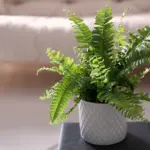
For readers asking, “Are Boston ferns toxic to cats?” the ASPCA answer is specific: Boston fern is listed as non-toxic to cats. The database uses the scientific label Nephrolepis exalta bostoniensis, while current plant taxonomy recognizes Nephrolepis exaltata and treats the older bostoniensis varietal name as a synonym within that species.
This naming difference matters because nursery labels may show “Boston fern,” Nephrolepis exaltata, N. exaltata ‘Bostoniensis,’ or another horticultural variation. These labels generally point toward the familiar arching Boston fern, but you should still compare the plant and label rather than relying only on its shape.
Non-toxic status is also different from being an appropriate feline food. If a cat repeatedly pulls off fronds or consumes a substantial amount, contact your veterinarian for advice, especially if vomiting, diarrhea, reduced appetite, or other changes occur.
For help distinguishing and maintaining this plant, see the full Boston fern identification and care guide.
Asparagus Fern and Cats
Asparagus fern requires a different answer. The ASPCA lists Asparagus densiflorus cultivar ‘Sprengeri’ as toxic to cats. It is a flowering plant in the genus Asparagus, not a true fern.
The ASPCA identifies sapogenins as the toxic principle in its entry for this plant. It reports that repeated skin exposure may cause allergic dermatitis and that ingestion of the berries may result in gastric upset, including vomiting, abdominal pain, or diarrhea.
Those are plant-specific findings. They should not be expanded into a generic list of “fern poisoning symptoms” for every fern or fern-like plant.
Sprengeri fern, emerald fern, emerald feather, lace fern, plumosa fern, racemose asparagus, and shatavari. Nursery naming varies, so compare the complete scientific label rather than matching only one common name.
Foxtail fern is also commonly associated with Asparagus densiflorus cultivars. However, cultivar labeling and taxonomy can vary. Do not assume that every plant sold as “foxtail fern” has been evaluated under the exact ASPCA entry. Keep the label and seek case-specific advice if a cat chews it.
How to Identify Your Plant Correctly
Correct identification is the central safety step. A photograph can help, but a photograph alone may not distinguish closely related species or cultivars.
- Look for the original nursery label. Record the complete genus, species, variety, and cultivar name rather than only the common name.
- Photograph the entire plant. Include its overall growth habit, pot, stems, fronds or leaves, and any flowers, berries, spores, or exposed rhizomes.
- Take close photographs. Capture both sides of a frond or leaf, the base of the plant, and any identifying structures.
- Check a botanical source. Use a reliable taxonomy database such as Kew’s Plants of the World Online to determine whether the scientific name is accepted or has changed.
- Check a veterinary poison source. Search the ASPCA database or ask an animal poison-control specialist using the scientific name.
- Do not treat absence as proof. A plant missing from a database is not automatically non-toxic. The ASPCA states that its list is not all-inclusive.
What about maidenhair fern?
Maidenhair fern is a broad common name for plants in the genus Adiantum. A plant sold under that name might be Adiantum raddianum, A. capillus-veneris, or another species. Because the name is not species-specific, this page does not give every maidenhair fern one universal toxicity classification.
Use the label from your plant and then check that exact name. The Learn About Ferns maidenhair fern guide can help with general recognition and care, but it should not replace a veterinary poison database.
What about bird’s nest fern?
Bird’s nest fern can refer to Asplenium nidus, Asplenium antiquum, and related species with broad fronds arranged in a central rosette. A safety statement for one species should not automatically be transferred to every plant sold under the same common name.
What about staghorn fern?
The ASPCA specifically lists Platycerium bifurcatum and Platycerium alcicorne as non-toxic to cats. Other plants may also be sold as staghorn ferns, so check the species instead of assuming that the common name covers every member of the genus.
What to Do If Your Cat Chews an Unknown Plant
If the plant is unknown, may be toxic, or your cat is showing signs of illness, contact your veterinarian or a local animal poison control service promptly. In the United States, the ASPCA Animal Poison Control Center can be reached at 888-426-4435. A consultation fee may apply.
- Prevent further access. Move the cat away from the plant and secure any fallen leaves, berries, or plant fragments.
- Keep the plant evidence. Save the nursery label, receipt, packaging, or a small plant sample if it can be handled safely.
- Take clear photographs. Photograph the full plant and the parts your cat may have chewed.
- Record what happened. Note the approximate time, plant part involved, possible amount, and any changes you have observed.
- Call your veterinarian or poison control. Give them the scientific name when available and follow their instructions.
Do not induce vomiting, give medication, administer home remedies, or attempt a specific treatment unless a veterinarian or poison-control professional directs you to do so. Cornell’s Feline Health Center warns that inducing vomiting can cause additional harm with some poisons.
Do not delay professional advice solely because your cat currently appears normal. The significance of an exposure depends on the plant, plant part, amount, and individual animal.
How to Reduce Plant-Chewing Risk
- Buy plants with a complete scientific label and retain the label after repotting.
- Check new plants against a veterinary toxic and non-toxic plant database before bringing them into a cat-accessible area.
- Avoid plants with uncertain identities, especially those sold only as “assorted fern” or “foliage plant.”
- Use secure hanging baskets, wall mounts, enclosed plant cabinets, or rooms the cat cannot enter.
- Remember that a high shelf may still be reachable to a climbing or jumping cat.
- Remove fallen fronds, berries, and loose plant material promptly.
- Ask your veterinarian for guidance if plant chewing is frequent or difficult to prevent.
Good plant care can also reduce dropped fronds and damaged growth that may attract attention. Review the site’s indoor fern care instructions for light, humidity, and watering guidance, and use the fern troubleshooting guide when a plant begins shedding, browning, or declining.
Frequently Asked Questions
Are ferns poisonous to cats?
Some commonly grown true ferns are listed as non-toxic to cats, but “fern” is not a sufficient identification. Check the scientific name. Plants that are not true ferns, especially the ASPCA-listed Sprengeri asparagus fern, may be toxic.
Are Boston ferns toxic to cats?
No. The ASPCA lists Boston fern as non-toxic to cats. Its accepted species name is Nephrolepis exaltata, although older horticultural labels may include “bostoniensis.” Non-toxic status does not mean that cats should be allowed to eat it.
Is asparagus fern toxic to cats?
Yes, the ASPCA lists Asparagus densiflorus cultivar ‘Sprengeri’ as toxic to cats. The ASPCA reports possible allergic dermatitis after repeated skin exposure and gastric upset after berry ingestion.
Can a non-toxic fern still make a cat vomit?
Yes. The ASPCA states that consuming any plant material may cause vomiting or gastrointestinal upset. This does not necessarily mean the plant contains a specific toxin, but it is still a reason to discourage chewing and contact a veterinarian when symptoms occur.
Is maidenhair fern safe for cats?
“Maidenhair fern” refers to multiple Adiantum species. Confirm the exact scientific name and check it in a current veterinary poison source. Do not apply a statement about one maidenhair species to every plant carrying the common name.
Is bird’s nest fern safe for cats?
The common name may refer to several Asplenium species, including A. nidus and A. antiquum. Identify the exact species before making a toxicity decision rather than relying on the common name alone.
Are staghorn ferns toxic to cats?
The ASPCA lists common staghorn fern, Platycerium bifurcatum, and Platycerium alcicorne as non-toxic to cats. Check the label because additional species may be sold under the same common name.
What should I do when I cannot identify the plant?
Keep the plant label, take photographs of the whole plant and the chewed parts, prevent further access, and contact your veterinarian or an animal poison control service. Do not induce vomiting or give medication unless instructed by a professional.
References
Plant records and guidance were checked by scientific name. Database entries can be updated, so recheck the source when evaluating a new exposure.
- ASPCA Animal Poison Control Center — Toxic and Non-Toxic Plants Database
- ASPCA — Boston Fern
- ASPCA — Asparagus Fern
- ASPCA — Common Staghorn Fern
- ASPCA — Platycerium alcicorne
- ASPCA — Hare Fern / Rabbit’s Foot Fern
- ASPCA — Cliff Brake / Button Fern
- ASPCA — Sword Fern
- ASPCA — Mother Fern
- Royal Botanic Gardens, Kew — Nephrolepis exaltata, Plants of the World Online
- Royal Botanic Gardens, Kew — Nephrolepis exaltata var. bostoniensis synonym record
- Royal Botanic Gardens, Kew — Asparagus densiflorus, Plants of the World Online
- Cornell Feline Health Center — Common Cat Hazards
- UC Davis School of Veterinary Medicine — Cat Health and Poisonous Plants
- Pet Poison Helpline — Plant Material and Gastrointestinal Irritation