
Fern problem diagnosis
Fern Pests and Diseases: Identification, Prevention and Safe Management
Brown spots, yellow fronds, white material and tiny bumps do not automatically mean that a fern has an insect or infectious disease. Start by separating normal fern structures and environmental stress from true pests, mites, nematodes and plant pathogens.
Quick answer
Do not diagnose a fern from one symptom alone
The same visible symptom can have several causes. Yellowing may result from wet roots, dry roots, low light, fertilizer salts, natural aging or a root pathogen. Brown marks may be dry tissue, sun injury, physical damage, bacterial lesions, fungal blight or foliar nematode damage. Wilting can occur when the potting mix is too dry or when damaged roots can no longer supply water.
A useful diagnosis combines the fern’s identity, the location and pattern of symptoms, recent care changes, potting-medium condition, root condition, speed of progression and visible evidence of an organism. Plant disease specialists distinguish infectious diseases from abiotic disorders caused by environmental or cultural conditions; photographs alone may not provide enough information for a definitive diagnosis. 1 2
Is it really a pest or disease?
Normal fern structures that can look alarming
Ferns have reproductive and protective structures that may be unfamiliar to growers accustomed to flowering plants. Before treating brown dots, white material or curled growth, check whether the feature occurs in a regular pattern and is consistent with the species.
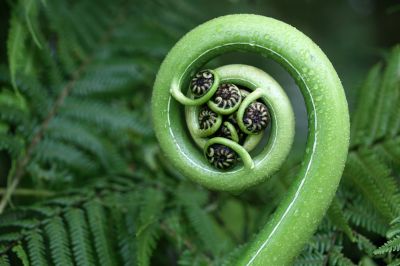
A curled fiddlehead is normal new growth
Young fern fronds commonly emerge as tightly curled croziers or fiddleheads and gradually unroll. This is different from a mature, previously expanded frond that begins to curl inward, wrinkle or collapse.
For mature-frond symptoms, see why fern leaves curl. Normal new growth should not be sprayed or manually forced open.
| What you see | Normal structure | Possible pest or problem | How to tell the difference |
|---|---|---|---|
| Brown, tan or black dots beneath mature fronds | Sori containing sporangia that produce spores | Scale insects or insect eggs | Sori are usually fixed in regular rows, lines, circles or species-specific patterns. Scale is more irregular and may occur on stems, veins and both frond surfaces. |
| White, gray or silvery coating | Natural hairs, scales, farina or waxy material on some species | Mealybugs, shed skins, fungal growth or residue | Normal coverings are generally consistent across comparable fronds. Mealybugs have distinct bodies, filaments and clustered wax, often around veins or protected joints. |
| Tightly curled green growth | Developing crozier or fiddlehead | Distorted growth from pests, stress or injury | A normal crozier develops from the crown and progressively unfurls. Abnormal curling affects an already expanded frond or remains distorted as it grows. |
| One older frond yellowing or browning | Natural frond aging | Root stress, pests or disease | Natural aging usually affects the oldest fronds gradually while new growth remains healthy. Widespread or rapid decline needs further investigation. |
| Fine pale scales on a staghorn fern | Protective surface covering | Dust, mealybugs or mildew | Do not scrub healthy staghorn fern surfaces. Inspect for separate moving insects, cottony clusters or a coating that is spreading irregularly. |
Sori are groups of spore-producing structures that commonly occur on the undersides of fertile fronds. Their arrangement varies among fern species, but a repeated, orderly distribution is a strong clue that they are reproductive structures rather than insect eggs. 4
When uncertain, identify the fern by its scientific name and compare several mature fronds. Avoid scraping, wiping or spraying a normal surface feature until its function is understood.
Diagnostic checklist
Start with the pattern, not a pathogen name
A single brown patch does not identify a fungus, and a wilted fern does not prove root rot. Record what is happening before changing several care factors at once.
- Identify the fern. Boston ferns, maidenhair ferns, bird’s nest ferns, staghorn ferns and hardy garden ferns do not have identical structures or tolerances.
- Find the first affected area. Is damage beginning on old fronds, tender new growth, frond tips, the crown, roots or fronds touching the potting mix?
- Describe the pattern. Is it uniform, one-sided, scattered, vein-limited, concentrated near the soil line or spreading between neighboring fronds?
- Check the speed. A rapidly enlarging, water-soaked lesion is more concerning than a stable dry mark left after a brief care problem.
- Inspect both frond surfaces. Use bright light and magnification to look for mites, insects, webbing, honeydew, cast skins, frass and feeding scars.
- Examine the growing medium and roots. Note odor, drainage, saturation, compaction, root color and whether the outer root tissue is soft or easily removed.
- Review recent events. Include repotting, fertilizer, pesticide use, cold drafts, heat, direct sun, missed watering, prolonged wetness and movement indoors or outdoors.
- Compare nearby plants. Similar symptoms appearing at the same time may indicate a shared environmental event, while pest movement or splash-dispersed disease may produce a different pattern.
| Symptom | Possible causes | What to inspect next |
|---|---|---|
| Brown tips or crisp edges | Drying, inconsistent watering, soluble salts, fertilizer injury, heat or damaged roots | Potting-medium moisture, fertilizer history, water quality, root health and whether only exposed edges are affected |
| Scattered brown spots | Physical injury, droplets exposed to intense light, chemical injury, fungal or bacterial leaf spot, foliar nematodes | Whether spots are dry or water-soaked, expanding or stable, vein-limited, associated with wet foliage or producing visible growth |
| Yellowing and wilting | Dry roots, saturated roots, low light, root-bound conditions, salt injury, root rot or natural aging | Root system, drainage, moisture depth, newest versus oldest fronds and progression after correcting care |
| Pale stippling with fine webbing | Spider mites | Undersides of fronds with magnification; tap a frond over white paper and watch for moving specks |
| Sticky surfaces or black sooty growth | Honeydew-producing aphids, mealybugs or soft scale | Veins, stems, crowns, new growth, pot rims and surfaces directly above the sticky residue |
| Silvery streaks with dark specks | Thrips or physical abrasion | Tender growth and frond undersides for slender moving insects and small dark fecal spots |
| Irregular holes or ragged margins outdoors | Slugs, snails, caterpillars or other chewing animals | Inspect after dark and beneath debris for slime, larvae, frass and fresh feeding |
| Tiny flies above the potting mix | Fungus gnats or another small fly | Sticky cards for adults, moisture conditions and translucent dark-headed larvae in the upper growing medium |
Abiotic versus infectious
Environmental damage can closely resemble disease
Abiotic or physiological problems
These arise from nonliving factors such as excessive or insufficient water, poor drainage, unsuitable light, temperature extremes, fertilizer salts, chemical exposure, physical injury or an unsuitable potting mix.
Damage may appear relatively uniform, follow an environmental event or affect several plants exposed to the same conditions. Abiotic damage does not spread as a living organism, although new damage can continue while the cause remains.
Infectious diseases
Infectious diseases involve organisms such as oomycetes, fungi, bacteria, viruses or plant-parasitic nematodes. Their development depends on a susceptible host, a suitable environment and the presence of the pathogen.
Progressive lesions, water-soaked tissue, pathogen growth, disease moving through connected tissue or similar symptoms appearing after contaminated water, tools or plants can justify further investigation.
These distinctions are clues rather than absolute rules. Root oxygen deprivation from saturated potting mix may occur without a pathogen, but the same wet conditions can also favor root-infecting organisms. Laboratory examination may be required to separate them.
Common fern pests
Look for the organism or its characteristic evidence
Houseplant pest management begins with close inspection. Many pests are introduced on a newly purchased or recently moved plant, and early isolation can reduce spread. A hand lens is useful because mites, crawlers and young thrips may be difficult to see. 5
| Pest | Identification clues | Typical damage | First management step |
|---|---|---|---|
| Spider mites | Very small moving specks, often beneath fronds; fine webbing when populations are high | Pale stippling, bronzing, yellowing and drying | Isolate, confirm with magnification or a white-paper tap test, then rinse if the species tolerates it |
| Scale insects | Fixed brown, gray or white covers along veins, stems or frond surfaces; crawlers are mobile | Yellowing, reduced vigor; soft scales may produce honeydew | Distinguish irregular insects from patterned sori and physically remove limited infestations |
| Mealybugs | White waxy insects with cottony clusters or filaments, including protected joints and sometimes roots | Stunting, yellowing, wilting, honeydew and leaf drop | Isolate and remove visible insects carefully without soaking the fern in household alcohol |
| Aphids | Soft pear-shaped insects clustered on tender growth; shed white skins may remain | Distorted new growth, yellowing and sticky honeydew | Rinse or remove colonies and inspect neighboring plants |
| Thrips | Slender, fast-moving insects; silvery scars and tiny dark fecal spots | Irregular pale streaks, scarring and distorted tender growth | Confirm insects with magnification or sticky cards before treatment |
| Fungus gnats | Small dark flies near moist potting mix; translucent larvae with dark heads | Adults are mainly a nuisance; larvae feed mostly on fungi and decaying matter but may damage fine roots | Correct prolonged surface wetness without drying the fern beyond its tolerance |
| Slugs and snails | Slime trails and feeding that is often most active at night | Irregular holes, missing tissue and damaged emerging fronds | Inspect after dark and remove hiding places where practical |
| Caterpillars and other chewing insects | Larvae, frass, eggs or fresh feeding along frond margins | Ragged edges, holes and partially eaten pinnae | Handpick identifiable larvae when safe to do so |
Spider mites
Spider mites are favored by warm, dry conditions and may reproduce quickly indoors. Early injury often appears as many tiny pale dots rather than a few large spots. Tap a suspect frond over white paper and watch the fallen specks for movement.
Increasing humidity may make the environment less favorable for some spider mites, but humidity alone is not a complete treatment and should not replace removal, washing, monitoring or a correctly labeled control. Excessively wet foliage may create other problems. Remove badly damaged fronds only when the plant retains enough healthy foliage, and repeat inspections because eggs or hidden mites may remain.
Scale insects
Scale insects can be mistaken for fern sori. Sori generally repeat in an orderly pattern on fertile fronds. Scale may occur on nonfertile fronds, stems, veins, crowns, pot rims or nearby surfaces and does not follow the fern’s reproductive pattern.
Limited infestations may be managed by careful physical removal. Inspect repeatedly for small mobile crawlers. Do not assume that alcohol, oil or insecticidal soap is safe for every fern; delicate fronds and natural surface coatings can be damaged.
Mealybugs
Mealybugs are soft-bodied insects covered with white wax. They often shelter along veins, at the base of fronds, around crowns or in other protected areas. Some species may occur below the potting-medium surface. Honeydew, sticky furniture surfaces and black sooty growth can accompany an infestation.
Isolate the plant and remove accessible insects with forceps or another gentle mechanical method. An alcohol-dipped swab is sometimes mentioned in Extension guidance for individual insects, but it should not become a blanket recommendation for ferns. Alcohol can injure plant tissue, remove protective coatings and create avoidable indoor exposure. Confirm the plant’s tolerance and follow authoritative guidance before using it.
Aphids
Aphids gather on soft new growth and use piercing-sucking mouthparts. Look for clusters of visible insects, distorted young fronds, honeydew and pale shed skins. They are not the only cause of curling or yellowing, so direct evidence matters.
A controlled stream of water can dislodge aphids from a sturdy fern. Protect the potting mix from becoming waterlogged and avoid breaking tender fronds. Continue inspecting the plant and nearby hosts rather than assuming a single rinse has eliminated every life stage.
Thrips
Thrips may affect foliage plants, but they should be included in the diagnosis only when the insect or characteristic feeding evidence is present. Feeding may leave irregular silvery streaks, scars and dark fecal specks. Mechanical rubbing, water spots, old damage and other pests can produce superficially similar marks.
Use a hand lens, inspect tender growth and consider yellow or blue sticky cards as monitoring tools. Sticky cards reveal flying adults but do not show the entire population and do not by themselves control immature stages hidden on the plant.
Fungus gnats
Adult fungus gnats are small, weak-flying insects often noticed around containers or windows. Adults do not feed on the fern. Their larvae live in moist growing medium and feed mainly on fungi, algae and decaying organic matter, although they can also feed on fine roots or plant tissue touching the surface. 6
Yellow sticky cards help detect and reduce some adults but do not treat larvae. Inspect the upper growing medium and correct prolonged wetness while respecting the species’ moisture requirements. A maidenhair fern should not be dried as aggressively as a drought-tolerant houseplant. Old, compacted mix that remains saturated may justify repotting into an appropriate fresh medium.
Slugs, snails and outdoor chewing pests
Outdoor ferns may develop holes and ragged edges from slugs, snails, caterpillars or other chewing animals. Inspect at night, beneath fronds, around the crown and under nearby boards, pots, stones or plant debris. Slime suggests slugs or snails; pellets of frass and a visible larva suggest a caterpillar or similar feeder.
Hand removal and habitat management are often sufficient for localized damage. Do not apply a broad-spectrum insecticide merely because a frond has holes. The feeding may be old, the pest may already be gone, or the culprit may not be susceptible to the chosen product.
Common fern diseases
“Leaf spot” and “root rot” describe symptoms, not complete diagnoses
Fern disease references document problems including Pythium root rot, Rhizoctonia blight, bacterial blight of bird’s nest ferns and foliar nematode injury. These diagnoses are associated with particular hosts and symptom patterns; they should not be assigned to every fern with brown or yellow tissue. 7
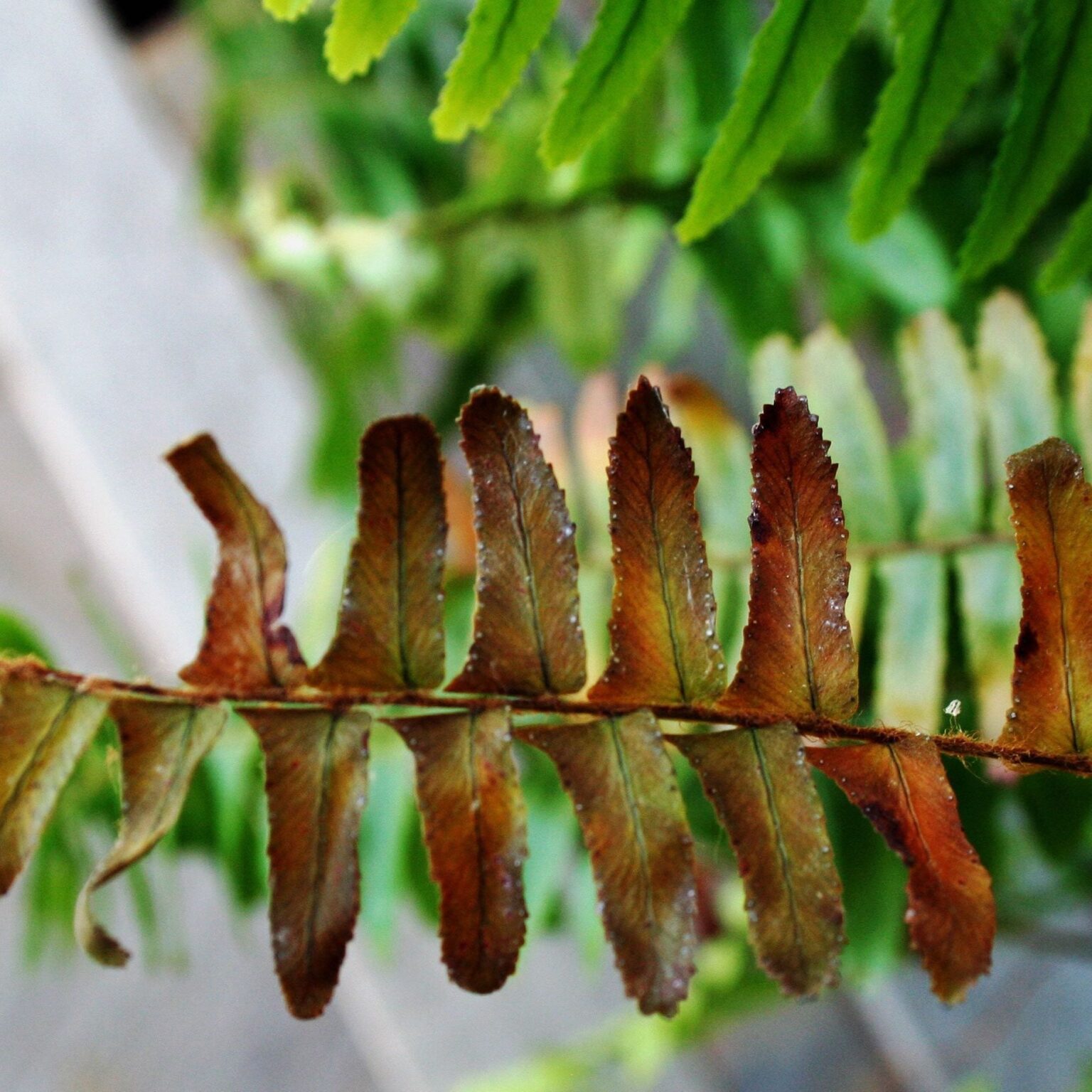
Root rot and root dysfunction
A fern can wilt in wet soil because saturated conditions displace oxygen and damage roots, even when no pathogen has been confirmed. Pythium species are water molds associated with root disease under favorable wet conditions, while other organisms and noninfectious root injury can produce similar aboveground symptoms.
Remove the plant from its decorative cover pot and check whether water is trapped around the container. If examination is justified, slide the root ball out carefully. Healthy root appearance varies by species, but concern increases when fine roots are extensively brown or black, soft, water-soaked, foul-smelling or losing their outer tissue. Pythium-associated root rot can produce brown to black root decay, stunting, wilting and collapse under wet conditions, but these observations are not sufficient to identify the organism without testing. 8
Do not treat every wet, wilted fern with a fungicide. First correct standing water, blocked drainage and inappropriate watering. When valuable plants continue to decline or several plants are affected, submit roots and growing medium to a diagnostic laboratory before selecting a disease-specific treatment.
Rhizoctonia blight
Rhizoctonia can cause rapidly spreading, irregular brown areas near the crown or on fronds. Fern disease references describe fungal webbing extending between affected fronds in some cases. Because physical collapse, Botrytis, bacterial disease and other pathogens can also produce blighted tissue, suspected Rhizoctonia should be confirmed when the diagnosis will determine pesticide use.
Remove dead plant debris, prevent contaminated potting mix from contacting fronds and reduce unnecessary splash. Do not reuse contaminated containers, tools or growing medium without appropriate cleaning and sanitation.
Leaf spots and frond blights
Brown or black leaf spots may be caused by infectious organisms, but they may also follow sun exposure, cold damage, droplets, fertilizer salts, pesticide injury or abrasion. Note whether lesions begin at frond margins, remain dry, become water-soaked, develop a halo, stay between veins or expand during periods of prolonged leaf wetness.
Botrytis and other foliar pathogens are possible on suitable hosts under favorable conditions. Botrytis is associated with blighted tissue and may produce gray, fuzzy sporulation during humid conditions, particularly on injured, aging or dead material. Gray growth should be examined rather than assumed from a photograph. Sanitation, removal of dead tissue and avoiding prolonged leaf wetness are central preventive measures. 9
Bacterial problems, especially on bird’s nest ferns
Bacterial blight is formally documented on Asplenium, including bird’s nest ferns. Reported symptoms include translucent or water-soaked spots that enlarge quickly and become reddish-brown, sometimes with darker or purplish margins. Rapid expansion and splash-associated spread are more concerning than isolated dry scars.
Isolate a suspect plant, avoid splashing water between plants, disinfect tools between specimens and remove severely affected plants from the collection. Do not apply a bactericide without a reliable diagnosis and a label that permits the use on the plant and site.
Foliar nematodes
Foliar nematodes are microscopic roundworms, not insects. On susceptible ferns such as some Asplenium, documented symptoms can begin as dark green areas near the base of fronds and progress to brown or black tissue. Lesions may be constrained by veins because the nematodes move through wet films and enter leaf tissue. 10
Do not use an insecticide intended for aphids, mites or scale against a suspected foliar nematode. Avoid moving water from affected foliage onto healthy plants and contact an Extension service or diagnostic laboratory. Discarding a heavily affected plant may be the safest practical option for a home collection.
Possible viral symptoms
Mottling, rings, unusual color breaks or distorted growth may raise concern about a virus, but visual symptoms are not enough to confirm one. Nutritional disorders, mites, thrips, chemical injury, unstable variegation and root problems can create similar patterns.
Isolate the plant, avoid propagating or sharing it, disinfect cutting tools and seek diagnostic assistance if symptoms persist in new growth. There is no justification for calling every mottled fern “mosaic virus” from a photograph.
Step-by-step inspection
How to inspect a fern without making the problem worse
- Move the fern away from other plants. Keep it in suitable light and temperature rather than placing it in a dark closet or harsh outdoor sun.
- Photograph the whole plant. Include the pot, growing location, crown, oldest fronds, newest fronds and both surfaces of affected tissue.
- Use bright light and magnification. Examine veins, rachises, crowns, frond undersides, pot rims, drainage holes and nearby furniture.
- Perform a white-paper tap test. Hold white paper below a suspect frond, tap gently and watch for moving mites or thrips.
- Check for residues and indirect evidence. Sticky honeydew, shed skins, webbing, slime, frass and black sooty growth can narrow the possibilities.
- Assess moisture below the surface. A dry crust can cover saturated mix. Check deeper without repeatedly disturbing fine roots.
- Inspect roots only when justified. Persistent wilting in wet mix, foul odor, container problems or rapid decline may warrant careful root examination.
- Mark and monitor lesions. Photograph spots beside a ruler or mark their edge on an expendable frond. Recheck progression over the next few days.
- Change one major care factor at a time. Simultaneously repotting, fertilizing, spraying and moving the fern makes the result harder to interpret.
- Escalate when evidence remains unclear. A local Extension office or plant diagnostic laboratory can advise which photographs, plant tissue, roots or growing medium to submit.
Isolation and sanitation
Prevent a local problem from becoming a collection-wide problem
Place a suspect indoor fern far enough from other plants that fronds do not touch. Avoid sharing drainage water, spray bottles, trays, cloths or pruning tools. Wash hands after handling an infested plant and clean tools before using them on another specimen.
Remove fallen fronds and decaying debris from the pot surface. Prune only tissue that is dead, heavily infested or specifically recommended for removal; excessive pruning can weaken a fern and eliminate useful diagnostic evidence. Bag diseased material before carrying it through a plant collection.
| Management issue | Indoor fern | Outdoor fern |
|---|---|---|
| Isolation | Separate from houseplants and avoid shared saucers or drainage water | Increase spacing when practical and avoid moving affected divisions to new areas |
| Rinsing pests | Protect floors and furniture; prevent the pot from becoming saturated | Use a controlled water stream and avoid spreading pests or contaminated splash to nearby plants |
| Natural enemies | Do not release lady beetles casually inside a home; biological control requires the correct species and conditions | Preserve beneficial organisms by avoiding unnecessary broad-spectrum pesticide use |
| Chewing pests | Usually introduced with plants or potting material; inspect containers and hiding places | Inspect at night for slugs and snails and check for caterpillars, frass and fresh feeding |
| Pesticide site | The label must permit indoor use and use on houseplants or the specific ornamental site | The label must permit use on ornamentals in the relevant outdoor location and against the identified target |
| Exposure concerns | Consider children, pets, indoor air, food-preparation areas, floors, walls and furniture | Consider pollinators, wildlife, runoff, wind, rain, nearby water and neighboring plants |
For broader environmental care, compare the guidance for indoor fern care and outdoor fern care. Species-specific differences are also important for Boston ferns, maidenhair ferns and staghorn ferns.
Integrated pest management
Use an IPM sequence instead of starting with a spray
Integrated pest management combines identification, monitoring, cultural correction, physical controls and carefully selected pesticides only when needed. This reduces unnecessary treatment and helps preserve evidence needed for diagnosis.
Pesticide safety
When a pesticide may be appropriate
A pesticide may be considered when the pest has been reasonably identified, nonchemical measures are insufficient and a registered product is labeled for the intended use. The label defines where, how and against which organisms the product may legally be used.
- Confirm that the label covers the target pest or disease rather than relying on a broad marketing description.
- Confirm that the label permits use on houseplants, ornamentals or the specific plant and location involved.
- For indoor treatment, use only a product formulated and labeled for indoor use.
- Follow all label directions for application, protective equipment, ventilation, reentry, storage and disposal.
- Do not create a stronger mixture, combine products or substitute a household recipe.
- Do not assume that “natural,” botanical, organic or plant-derived means harmless to people, pets or ferns.
- Keep children, pets, food items, toys and unnecessary people away from the treatment area as directed by the label.
- Protect furniture, walls, flooring, aquariums and other surfaces from drift or residue.
- When the label and Extension guidance allow it, test a small number of fronds for plant sensitivity before treating the whole fern. A test does not override label restrictions.
- Do not treat a severely moisture-stressed fern unless the label and authoritative guidance indicate that it is appropriate.
The National Pesticide Information Center recommends using only pesticides formulated for indoor use when treating indoors, following the label, improving ventilation and using an IPM approach. Safe-use guidance also emphasizes keeping children and pets away from mixing and application areas and removing personal items that could be contaminated. 11 12
Escalation decisions
When to discard a fern
Discarding a plant can be the most proportionate choice when it is inexpensive to replace, heavily infested, extensively rotted or likely to spread an unresolved problem to valuable plants. This is especially reasonable when repeated treatment would create significant indoor exposure or require more time than the plant is worth.
Consider removal when scale or mealybugs are established throughout a dense crown, root mealybugs are widespread, most roots are decayed, bacterial-looking lesions are expanding rapidly, foliar nematodes are suspected or the plant continues to decline despite corrected care. Bag the plant and potting mix before moving it through the collection. Clean the growing area and do not immediately reuse contaminated mix.
When to contact Extension or a diagnostic laboratory
Seek professional diagnostic assistance when:
- Water-soaked or translucent lesions are expanding rapidly.
- Several ferns develop similar symptoms without an obvious shared care problem.
- Root decay continues after drainage and watering problems have been corrected.
- Lesions appear bounded by veins and foliar nematodes are suspected.
- New growth repeatedly develops mottling, rings or unexplained distortion.
- You cannot distinguish sori or normal coverings from a pest.
- The fern is rare, expensive, part of a large collection or intended for propagation and distribution.
- A pesticide decision depends on knowing the organism involved.
Diagnostic laboratories may examine plant tissue, roots, potting medium, insects or nematodes and may use culture, microscopy, serological or molecular methods when appropriate. Home gardeners are commonly directed to begin with their local county or regional Extension office. 13
Prevention
Reduce risk without trying to make the fern sterile
- Inspect before buying. Check frond undersides, crowns, stems, pot rims, drainage holes and the growing-medium surface.
- Quarantine new plants. Keep new or recently outdoor-grown ferns separate long enough to inspect them repeatedly.
- Match the environment to the species. Suitable light, temperature, humidity and watering improve resilience without guaranteeing freedom from pests.
- Provide drainage. Use a suitable pot and growing medium, empty standing water and avoid keeping roots continuously saturated.
- Avoid prolonged unnecessary leaf wetness. Water in a way that allows fronds to dry within a reasonable period, especially where bacterial or foliar disease is a concern.
- Keep tools and containers clean. Remove old roots and potting debris and clean equipment before using it on another plant.
- Remove dead material. Decaying fronds and organic debris can support fungus gnats and provide tissue for opportunistic pathogens.
- Do not overfertilize. Excess soluble salts can damage roots and frond tips and may be mistaken for disease.
- Inspect during routine care. Look closely whenever you water, clean, fertilize or move the fern.
- Keep records. Dates and photographs make slow changes and treatment outcomes easier to evaluate.
Frequently asked questions
Fern pest and disease questions
Are the brown dots under my fern leaves insect eggs?
Often they are normal sori containing sporangia. Sori usually form a consistent, species-specific pattern on mature fertile fronds. Irregular bumps on stems, veins and unrelated parts of the plant require closer inspection for scale or other pests.
Does every brown spot on a fern mean fungal disease?
No. Brown spots can result from dry tissue, direct sun, cold, fertilizer salts, chemical injury, physical damage, bacteria, fungi or foliar nematodes. Pattern, progression, moisture conditions and laboratory testing may be needed.
Does a yellow, wilted fern have root rot?
Not necessarily. Dry roots, saturated roots, low light, natural aging and fertilizer injury can produce similar symptoms. Examine the growing medium, drainage and roots before assigning a root-rot diagnosis.
Will increasing humidity eliminate spider mites?
No. Warm, dry conditions may favor spider mites, but raising humidity does not remove existing mites and eggs. Confirm the pest, isolate the plant, use appropriate physical controls and continue monitoring.
Is neem oil safe for every fern?
No universal safety claim can be made. Fern species, product formulations, environmental conditions and application methods differ. Use only a product labeled for the plant, site and target, and follow all directions.
Can I use dish soap as insecticidal soap?
Household detergents are not equivalent to registered insecticidal soap products and can burn plant tissue. Do not create a homemade pesticide mixture. Use an appropriately labeled product only when treatment is justified.
Should I release ladybugs inside my home?
Generally no. Biological control depends on the correct natural enemy, pest, temperature, humidity and release system. Lady beetles released casually indoors may disperse into the home rather than provide reliable fern pest control.
Are fungus gnats killing my fern?
Adult fungus gnats are mainly a nuisance. Larvae live in moist growing medium and feed largely on fungi and decaying material, although they can injure fine roots, particularly on young or stressed plants. Their presence also indicates that the surface may be remaining moist for long periods.
Can one photograph identify a fern disease?
A photograph may narrow the possibilities but often cannot confirm a pathogen. Accurate diagnosis may require the whole-plant pattern, root examination, environmental history, microscopy, culturing or other laboratory tests.
Sources used
References and diagnostic resources
- Penn State Extension — Plant Disease Basics and Diagnosis
- NC State Extension — Diseases and Disorders
- National Pesticide Information Center — Do It Yourself Pest Control
- Mississippi State University Extension — Bumps on Fern Leaves
- University of Minnesota Extension — Managing Insects on Indoor Plants
- Colorado State University Extension — Managing Houseplant Pests
- Colorado State University Extension — Fungus Gnats as Houseplant and Indoor Pests
- Penn State Extension — Fern Diseases
- University of California IPM — Pythium Root Rot
- NC State Extension — Botrytis Blight of Greenhouse Ornamentals
- Penn State Extension — Foliar Nematodes
- University of Minnesota Extension — Slugs in Home Gardens
- National Pesticide Information Center — Indoor Air and Pesticides
- National Pesticide Information Center — Safe Use Practices for Pesticides
- Oklahoma State University Extension — Plant Disease and Insect Diagnostic Laboratory
This page provides general educational information. Pest occurrence, disease risk, pesticide registration and legal uses vary by fern species and location. Follow local regulations and the current product label, and consult a local Extension service or plant diagnostic laboratory when the cause is uncertain.