
Tree Fern Care: How to Grow and Protect Tree Ferns
Tree ferns share a tall, trunk-forming appearance, but they are not one plant with one set of requirements. Correct care begins by identifying the species.
Hero image shows a cultivated tree fern canopy and is not used as evidence of species identity.Quick Answer
“Tree fern” describes a growth form and a horticultural group, not a single species. Two commonly cultivated plants are Sphaeropteris cooperi, formerly and still often sold as Cyathea cooperi, and Dicksonia antarctica. They belong to different families and can differ substantially in growth rate, mature size, cold tolerance, trunk structure, watering practice, and winter care.
Sphaeropteris cooperi is generally the faster-growing, warmer-climate choice. UF/IFAS lists it for USDA Zones 10b through 11, while frost-prone gardeners are commonly advised to grow it in a movable container or protected structure. Dicksonia antarctica grows more slowly and is usually the better candidate for cool, humid gardens with mild winters, but it is not reliably hardy in severe or prolonged freezes.
Both need shelter from drying wind, moisture-retentive but aerated soil, adequate drainage, and protection of the single growing crown. Neither should be watered or fertilized according to a rigid calendar.
What Is a Tree Fern?
A tree fern is a fern with an upright, trunk-like stem that lifts its crown of fronds above the ground. The name is based mainly on appearance. Tree ferns occur in several botanical families, particularly Cyatheaceae and Dicksoniaceae, and individual species evolved under different tropical, subtropical, or cool-temperate conditions.
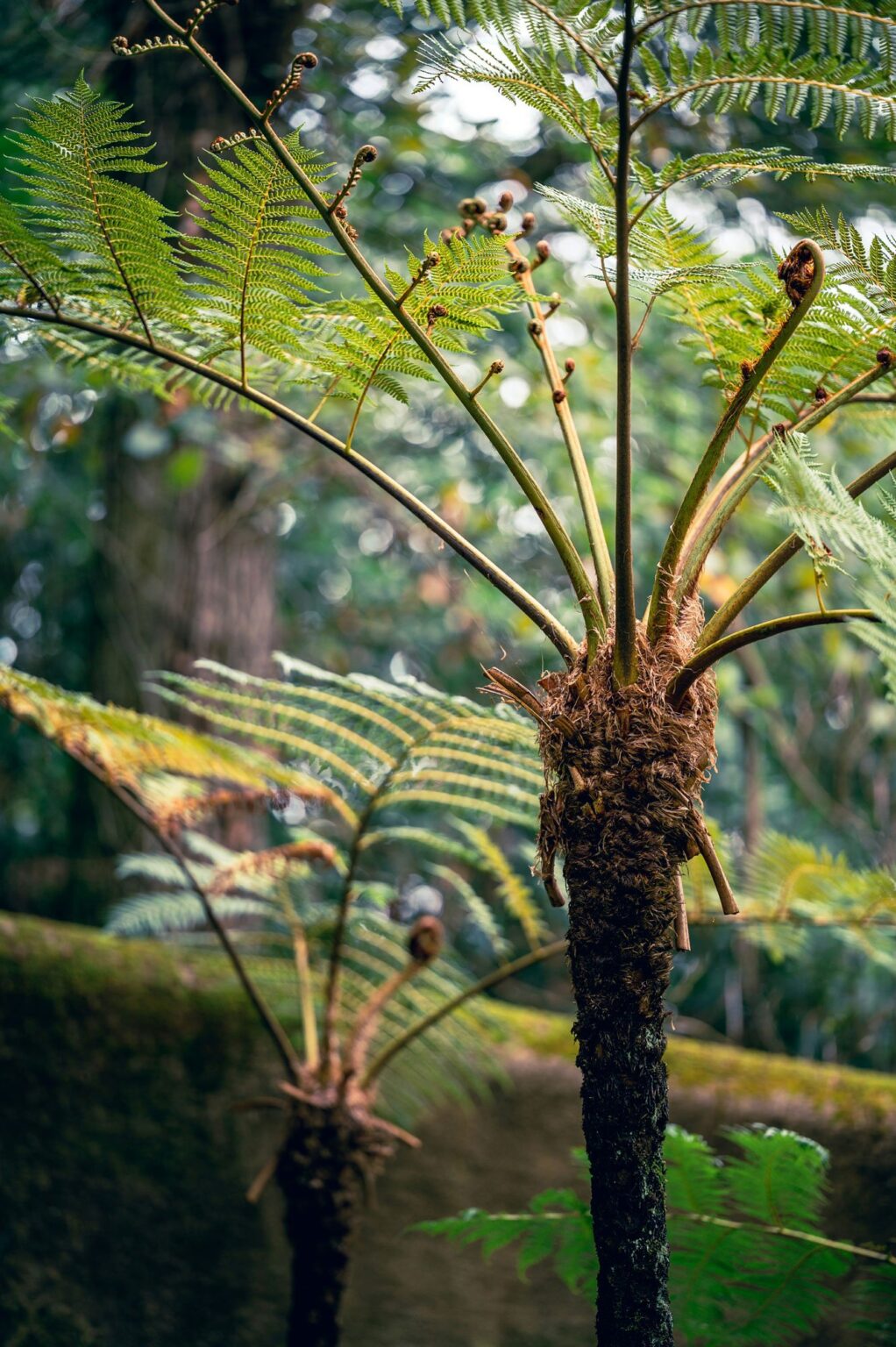
The apparent “trunk” is not a conventional woody trunk with the annual secondary growth found in most trees. It is primarily an erect rhizome surrounded by persistent frond bases, adventitious roots, fibrous material, or scales. Kew describes the trunk of Dicksonia antarctica as a slender central stem surrounded by a dense mass of fibrous roots. This living root mantle can also support mosses and other small epiphytes.
At the top is the crown, where tightly coiled new fronds emerge from the active growing point. Severe mechanical damage, deep freezing, or decay in this area can stop new growth. A single-trunked tree fern may have no dependable replacement crown, so avoid cutting, crushing, tying, or repeatedly flooding the growing point.
Tree Fern at a Glance
| Care factor | General guidance | Why species identification matters |
|---|---|---|
| Light | Filtered light, dappled shade, or sheltered partial shade is the safest starting point. | S. cooperi can tolerate brighter conditions when well established and irrigated, while D. antarctica is commonly grown in shaded, humid gardens. |
| Soil | Humus-rich, moisture-retentive, aerated soil that drains after irrigation. | A hot-climate landscape plant, a cool garden specimen, and a container plant do not need identical mixes. |
| Water | Keep the root zone evenly moist without creating stagnant, oxygen-poor soil. | Watering a fibrous Dicksonia trunk may help in hot weather, but crown watering is riskier for S. cooperi. |
| Wind | Shelter from persistent hot, dry, salty, or freezing wind. | Large fronds lose water rapidly and can tear even when the root system remains healthy. |
| Cold | Do not assume that survival after one brief frost proves long-term hardiness. | D. antarctica is generally more suitable for cool, mild-winter gardens than S. cooperi. |
| Growth | Growth depends on species, age, heat, light, water, root space, and length of growing season. | No annual growth rate applies to every tree fern or every climate. |
Sphaeropteris cooperi vs. Dicksonia antarctica
Kew accepts Sphaeropteris cooperi as the current name for the plant widely known as Cyathea cooperi. Nursery catalogs and older references may therefore use either name. Dicksonia antarctica is a separate species in a separate family and should not be treated as a synonym or slower form of the same plant.
| Feature | Sphaeropteris cooperi | Dicksonia antarctica |
|---|---|---|
| Frequently used names | Australian tree fern, lacy tree fern, Cooper’s tree fern, scaly tree fern; formerly Cyathea cooperi | Soft tree fern, Tasmanian tree fern, Australian tree fern |
| Family | Cyatheaceae | Dicksoniaceae |
| Native climate | Eastern Australian subtropical environments | Moist temperate forests, gullies, and creek environments of southeastern Australia |
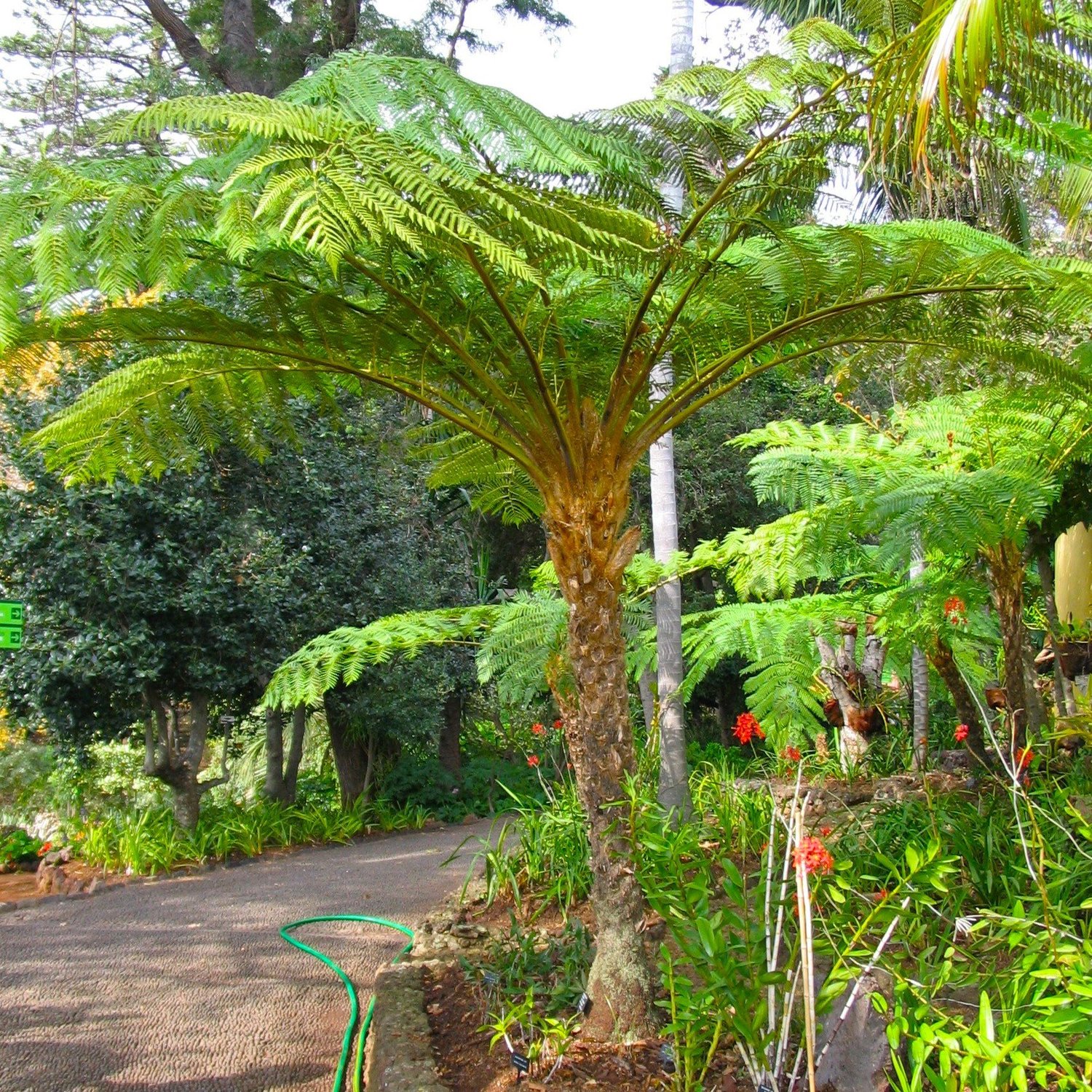
| Appearance | Usually a relatively slender, scale-covered trunk with conspicuous oval scars left by fallen fronds | A thicker-looking trunk densely covered by matted brown roots and fibrous material |
| Growth | Described by RHS and NC State as fast-growing under favorable conditions, but a dependable universal annual rate is not established | Slow-growing. Kew reports approximately 1–10 cm of trunk growth per year depending on conditions; an RHS UK guide gives about 2.5 cm per year |
| Reported size | UF/IFAS gives approximately 15–30 ft in landscapes; NC State notes that wild plants may reach about 50 ft | RHS lists about 8–13 ft in typical UK cultivation; Kew records wild trunks up to about 49 ft |
| Cold guidance | UF/IFAS lists USDA Zones 10b–11. RHS advises protected cultivation with a 50°F winter minimum in frost-prone areas | Missouri Botanical Garden lists USDA Zones 9–10. RHS rates it H3, corresponding to approximately 23–34°F under UK conditions, and recommends protection below about 23°F |
| Watering emphasis | Keep the root zone moist but drained. NC State advises watering at the base rather than routinely filling the crown because crown watering may contribute to rot | Keep the soil moist. Its fibrous trunk may be wetted in hot, dry weather, but avoid leaving the crown saturated in cool weather or winter |
| Propagation | Primarily by spores | By spores; some plants may produce offsets, but offset production is not guaranteed |
| Ecological concern | Invasive or environmentally problematic in Hawaii and some other nonnative regions | Wild collection and international trade may be regulated; purchase legally sourced plants |
Reported height and hardiness figures describe particular source conditions. They are not guarantees for an individual plant, exposed garden, container, or unusually severe winter.
Choosing the Right Tree Fern for Your Climate
Begin with winter lows, summer heat, humidity, rainfall pattern, wind exposure, and the number of months when active growth is possible. A hardiness-zone number alone does not describe soil freezing, cold duration, winter rain, wind, or repeated freeze-thaw cycles.
| Local conditions | Likely suitability | Practical decision |
|---|---|---|
| Frost-free, humid subtropical climate | S. cooperi may grow outdoors where it is not invasive. D. antarctica can grow where summer heat and drying are moderated. | Check local invasive-plant lists before buying S. cooperi. |
| Cool, humid climate with mild winters | D. antarctica is usually the stronger candidate. | Choose a shaded, wind-sheltered site and prepare winter crown protection. |
| Occasional light frost | D. antarctica may be grown outdoors with protection. S. cooperi remains a higher-risk choice. | Use a movable container for S. cooperi unless a protected, reliably mild microclimate is available. |
| Regular temperatures below 23°F (-5°C) | Neither species is a reliably unprotected landscape plant. | Grow in a container that can be moved to a frost-free structure, or choose a genuinely hardy woodland fern. |
| Hot, arid, or windy climate | Both can suffer chronic water stress. Warmth alone does not make a site suitable. | Provide afternoon shade, wind protection, mulch, and dependable irrigation before planting. |
| Small indoor room | Long-term suitability is poor because of eventual size, low humidity, and light limitations. | Reserve large tree ferns for greenhouses, conservatories, atriums, or seasonal container use. |
Tree Fern Light Requirements
Filtered light or sheltered partial shade is the safest starting condition for both species. An open canopy that provides bright morning light and protection from intense afternoon sun is often better than either deep darkness or an exposed, reflective site.
Dicksonia antarctica is commonly grown in full to partial shade. It can tolerate brighter light where the soil remains moist and humidity is adequate, but a recently planted or container-grown specimen can scorch before its root system supports the fronds.
Sphaeropteris cooperi is usually placed in partial shade. Established plants may tolerate stronger light in humid climates with consistent irrigation, but this does not mean that a plant moved from a shaded nursery can be placed immediately in full sun. Acclimate it gradually.
Signs of excessive light include pale or bleached areas, tan patches on the sun-facing side, curled leaflets, and rapid drying. Deep shade may produce weak, stretched fronds and slow growth. See the dedicated guide to fern sunlight and light requirements for help evaluating indoor and outdoor exposure.
Soil and Drainage
Tree ferns need moisture, but their roots also need oxygen. The goal is an organic, humus-rich root zone that absorbs water and then drains rather than remaining stagnant. Improve compacted soil over a broad planting area instead of filling a narrow hole with a radically different material that may hold water like a basin.
Both species generally suit acidic to neutral conditions. Dicksonia antarctica is associated with moist forest soils and benefits from decomposed leaf material. S. cooperi also prefers fertile, well-drained soil, but persistent saturation around its roots or crown can invite decline.
Do not assume that a standard indoor houseplant mix is adequate for a large outdoor tree fern. Container media must support a top-heavy plant, hold usable moisture, and still maintain air spaces after repeated watering. Learn more in the guide to soil and fertilizer for ferns.
How to Plant a Tree Fern
- Confirm the scientific name and source. Check the label, local invasive status, nursery provenance, and any permit or tag required for a mature trunk.
- Select a sheltered position. Allow room for the eventual frond spread and keep the crown away from roofs, walkways, power lines, and locations where ice or falling branches could damage it.
- Prepare the root zone. Loosen compacted soil and incorporate mature organic matter where appropriate without creating a permanently waterlogged pocket.
- Plant a rooted specimen at its nursery depth. Keep the crown above the soil line. Do not deeply bury the trunk in an attempt to make the plant more stable.
- Handle legally supplied Dicksonia trunks carefully. Where a legitimate supplier sells an established trunk form, follow its planting instructions. RHS guidance is to insert only enough of the base to keep it stable.
- Backfill and water thoroughly. Settle the soil without forcefully compacting it. Confirm that water moves away instead of pooling around the planting hole.
- Mulch the surrounding soil. Use leaf mold, composted bark, or another locally appropriate organic mulch, but do not pile mulch into the crown or deeply against the base.
- Monitor establishment. Newly planted tree ferns have less capacity to tolerate sun, wind, frost, or missed irrigation than established specimens.
How to Water a Tree Fern
There is no dependable instruction such as “water daily” or “water twice a week” for every tree fern. Irrigation demand changes with species, root establishment, soil texture, container size, temperature, wind, rainfall, shade, and season.
Check moisture below the mulch or upper dry surface. The root zone should feel evenly moist, not dusty and dry, but it should not smell sour or remain saturated for long periods. Container weight, drainage speed, frond condition, and recent weather are more useful than the day of the week.
Water deeply enough to moisten the active root zone. A quick splash that wets only the surface can encourage shallow rooting and may leave the center of a large root ball dry. During heat waves, inspect plants more frequently and water early enough that they enter the hottest part of the day hydrated.
For broader watering principles, see How Often Should I Water a Fern?
Should You Water the Trunk or Crown?
This is one of the areas where species and season matter most. Some traditional guidance for Dicksonia antarctica includes wetting its fibrous trunk during active growth and hot, dry weather. The root-covered trunk can absorb and retain moisture. However, Kew cautions that direct crown watering can encourage rot, while RHS specifically advises avoiding crown watering in winter.
For Sphaeropteris cooperi, NC State recommends watering at the base because water retained in the crown may contribute to rot. The safest general rule is therefore to prioritize the soil and root ball, treat trunk watering as a species-specific option, and never leave the crown persistently wet in cold or poorly ventilated conditions.
| Water location | When it may help | Main risk | Best practice |
|---|---|---|---|
| Soil and root zone | All rooted tree ferns during active growth and dry weather | Waterlogging where drainage is poor | Water thoroughly, then allow excess water to drain. Adjust frequency to weather and soil condition. |
| Fibrous trunk of D. antarctica | Hot, dry weather when the trunk is exposed and drying rapidly | Encouraging constant wetness in cold weather | Wet the trunk during warm active growth, while keeping the surrounding site aerated. |
| Crown of D. antarctica | Some growers allow rainfall or limited warm-season irrigation into an actively growing crown | Stagnant water and crown rot, especially in winter | Do not keep the crown filled with water. Avoid direct crown irrigation in cold weather. |
| Crown of S. cooperi | No routine need when the soil is correctly irrigated | Crown or root-zone decay | Direct irrigation to the base and root ball rather than repeatedly flooding the crown. |
| Fronds | Occasional rinsing may remove dust from protected container plants | Leaf spotting, pest spread, or prolonged nighttime wetness | Use clean water early in the day and provide airflow. |
Growing Tree Ferns in Containers
Containers make winter movement possible, but they also dry faster, heat more rapidly, and expose roots to colder temperatures than the ground. The pot must be stable enough to support a large crown and must have unobstructed drainage openings.
Use a moisture-retentive, humus-rich, structurally stable medium with adequate aeration. Suitable ingredients may include composted bark, coir, mature organic matter, loam, and mineral drainage components, but the correct proportions depend on the plant, container, and climate. Avoid a dense mix that collapses into mud or a very coarse mix that dries in a few hours.
Repot when roots have occupied the available medium, drainage has deteriorated, or the container has become dangerously unstable. Do not disturb the roots every year merely because a calendar says to do so. See How to Repot a Fern for container-selection and root-handling principles.
| Factor | Tree fern in the ground | Tree fern in a container |
|---|---|---|
| Root temperature | Moderated by surrounding soil | More exposed to heat and freezing |
| Watering | Usually changes more slowly after establishment | Requires more frequent inspection and complete wetting of the root ball |
| Winter options | Must be protected in place | Can be moved to a frost-free greenhouse, conservatory, garage with suitable light, or other protected space |
| Long-term size | Greater root volume and potentially larger growth | Growth and stability eventually limited by the container |
| Main risk | Poor site selection is difficult to correct | Rapid drying, root congestion, tipping, and cold injury to the root ball |
Fertilizing Tree Ferns
Tree ferns generally respond better to moderate nutrition than to repeated heavy feeding. Newly planted specimens should first establish an effective root system. During active growth, use a diluted complete fertilizer or an appropriately labeled controlled-release product if the soil or container medium is nutrient-poor.
Do not apply one universal monthly or biweekly schedule. A fast-growing S. cooperi in a warm, irrigated container may use nutrients differently from a slow-growing D. antarctica in cool garden soil. Reduce or stop feeding when growth slows, temperatures fall, the plant is drought-stressed, or roots are damaged.
Excess fertilizer can increase salt accumulation, damage fine roots, and produce weak growth. Diagnose pale fronds by checking drainage, root health, moisture, light, and temperature before assuming that fertilizer is the solution.
Mulching
An organic surface mulch reduces evaporation, buffers soil temperature, and gradually contributes organic material. Spread it across the root zone rather than building a mound against the trunk. Renew it as it decomposes, but do not bury the original soil line or allow decomposing material to fill the crown.
Pruning Old Fronds
Remove fronds after they are substantially brown, broken, diseased, or creating a safety problem. Cut the stipe cleanly without slicing into the trunk, crown, or emerging croziers. Green fronds continue to photosynthesize and should not be removed simply to make the crown look symmetrical.
Do not top a tree fern or cut through its crown to reduce height. These plants do not branch and respond like conventional woody trees. Severe crown damage can kill a single-crowned specimen.
Tree Fern Winter Care
Winter treatment must be based on the species and the actual site. A brief low temperature in dry, still conditions is not equivalent to several nights of freezing weather, frozen soil, cold wind, or a crown held wet beneath impermeable wrapping.
Dicksonia antarctica is the more cold-tolerant of the two plants discussed here, but RHS still classifies it as suitable mainly for mild UK locations and recommends protecting the crown in colder areas. S. cooperi should be treated more conservatively. UF/IFAS places it in USDA Zones 10b–11, and RHS recommends protected cultivation with a minimum winter temperature of 50°F in frost-prone regions.
| Forecast or situation | Dicksonia antarctica | Sphaeropteris cooperi |
|---|---|---|
| No frost expected | Leave unwrapped. Continue monitoring soil moisture during dry winter weather. | Leave outdoors only where winter conditions remain suitable and the species is legally and ecologically appropriate. |
| Brief light frost | Protect the crown with dry straw, bracken, or breathable horticultural fleece. Shelter from wind. | Move a container under cover. Protect an in-ground plant, but recognize that survival is uncertain. |
| Temperatures approaching 23°F (-5°C) | Use substantial breathable crown and upper-trunk insulation. Avoid trapping water against the growing point. | Outdoor exposure is high risk; move container plants to frost-free conditions before the event. |
| Repeated hard freezes or frozen soil | Not reliably hardy without specialized protection. Container culture or a protected structure is safer. | Not suitable for routine outdoor overwintering. |
| Container plant | Move to a cool, bright, frost-free, ventilated location before the root ball freezes. | Move to protected conditions before frost; RHS advises at least 50°F in frost-prone cultivation. |
| After the cold spell | Remove or loosen wet insulation when conditions improve. Do not assume brown fronds mean the crown is dead. | Check the crown and root zone, but do not guarantee recovery even if damage appears limited. |
Cold Damage
Frost-damaged fronds may become limp, translucent, dark brown, or black. Wait until damage is clear before pruning because partly green tissue may still support the plant. Protect the crown from additional freezes and keep the soil lightly moist rather than saturated.
Do not promise that a tree fern will produce new fronds after freezing. Recovery depends on whether the crown and vascular tissue survived, the duration of cold, root condition, and subsequent weather. A firm crown may justify waiting into the normal growth period; a soft, collapsing, foul-smelling crown suggests serious decay.
Hot and Dry Weather
During heat waves, provide temporary afternoon shade, protect the fronds from hot wind, check containers at least daily, and water the full root zone before severe wilting develops. A shallow mulch helps reduce evaporation.
For D. antarctica, wetting the fibrous trunk during hot, dry weather may reduce desiccation. For S. cooperi, concentrate irrigation at the base and avoid repeatedly filling the crown. Do not compensate for drought by leaving either plant in permanently saturated soil.
Common Tree Fern Problems
Tree Fern Brown Fronds
Brown fronds are a symptom, not a diagnosis. Examine which fronds are affected, where browning begins, how quickly it appeared, and what changed in the weather or care routine.
| Pattern | Possible cause | What to check | Response |
|---|---|---|---|
| One or two oldest lower fronds gradually brown | Normal frond aging | Healthy emerging fronds and a firm crown | Remove the old frond after it is substantially brown. |
| Crispy tips and margins on several fronds | Dry soil, hot wind, low humidity, or root congestion | Moisture beneath the surface, container weight, drainage, and exposure | Correct irrigation and shelter rather than repeatedly misting only the foliage. |
| Bleached or tan patches on the exposed side | Sun or heat injury | Recent relocation, reflected heat, and afternoon sun | Increase filtered shade and acclimate gradually. |
| Dark, collapsed fronds after freezing weather | Cold injury | Crown firmness, forecast, and condition of protected tissue | Protect from further cold and wait before concluding that the plant is dead. |
| Rapid crown collapse or foul odor | Crown or root decay | Standing water, buried crown, poor drainage, and repeated crown irrigation | Stop flooding the crown, improve drainage, and seek local diagnostic help. |
| Fine pale stippling, webbing, or dull foliage indoors | Spider mites | Undersides of leaflets and nearby plants | Isolate the plant and confirm the pest before treatment. |
| White cottony clusters on stipes or young growth | Mealybugs | Crown crevices and sheltered leaf bases | Quarantine and use a treatment labeled for the plant and growing location. |
For a wider symptom-based diagnosis, see Why Is My Fern Turning Brown?
Pests and Diseases
RHS describes outdoor D. antarctica as generally free of serious pest and disease problems. NC State advises monitoring S. cooperi for spider mites and mealybugs, especially in protected indoor or greenhouse conditions.
Inspect the underside of fronds before treating brown dots as insects. Regular, organized brown structures may be sori containing spores. Do not apply fungicide or insecticide until the problem has been identified. Improve airflow, drainage, sanitation, and irrigation practice first, and use your local Extension service or plant diagnostic laboratory when crown decay, unusual spotting, or rapid collapse is present.
See Fern Pests and Diseases for identification and management principles.
Propagation
Both principal species can be propagated from spores, but spore propagation is slow, contamination-sensitive, and variable. Do not promise germination within a fixed two-to-six-week period. Spore maturity, cleanliness, temperature, light, moisture, and species all affect development.
Dicksonia antarctica may occasionally form offsets from the trunk or roots. Leave an offset attached until it is large enough to have a realistic chance of establishment, and do not assume that every plant will produce one. S. cooperi is generally treated as a single-trunked species propagated by spores rather than by cutting the trunk.
The complete fern life cycle and sterile sowing procedure belong in a dedicated propagation article. See How to Grow Ferns from Spores rather than using a shortened, fixed-time recipe.
Invasive Species Considerations
Do not plant Australian tree fern without checking local status
Sphaeropteris cooperi has escaped cultivation and become invasive in parts of Hawaii. Hawaii government conservation material specifically lists Australian tree fern among ornamentals not to use, and the Hawaii Department of Land and Natural Resources identifies it as a priority invasive weed in protected natural areas.
Do not plant, distribute, or deliberately propagate this species where it is prohibited, discouraged, or under active control. Removing fertile fronds is not an adequate substitute for following local regulations or choosing a noninvasive plant.
Tree fern collection and trade can also be regulated. Tree-fern groups in Cyatheaceae and Dicksoniaceae are covered by international trade controls under CITES, and local laws may require licenses, provenance records, or official tags. Victoria, Australia, for example, regulates the taking and trading of tree ferns and other protected flora.
Never remove a tree fern from a forest, park, roadside, vacant property, or private land without confirming ownership and every applicable permit. Buy nursery-propagated or demonstrably legal stock and retain the label, receipt, and tag supplied with a mature specimen.
Tree Fern Care FAQ
Is Cyathea cooperi the same as Sphaeropteris cooperi?
They refer to the same species under different taxonomic treatments. Kew Plants of the World Online accepts Sphaeropteris cooperi, while Cyathea cooperi remains common on nursery labels and in older horticultural references.
Is Dicksonia antarctica an Australian tree fern?
Yes, but “Australian tree fern” is also used for S. cooperi and other species. The common name alone does not identify the plant.
How often should I water a tree fern?
Water according to soil moisture, root establishment, temperature, wind, rainfall, and container size. Keep the root zone evenly moist but not continuously waterlogged. Do not rely on a fixed weekly schedule.
Should I pour water into the crown?
Not as a universal practice. Prioritize the root zone. A D. antarctica trunk may be wetted during hot, dry active growth, but avoid leaving its crown wet in winter. For S. cooperi, direct water to the base rather than routinely flooding the crown.
Can a tree fern grow in full sun?
Some established plants tolerate brighter light where humidity and soil moisture are high, but filtered light or sheltered partial shade is safer. Newly planted and container-grown specimens scorch more easily.
Can tree ferns be grown indoors?
Young S. cooperi plants can be grown temporarily in bright, humid interiors, but long-term size and light requirements usually make a greenhouse, conservatory, atrium, or seasonal container arrangement more practical.
Will a tree fern recover after frost?
Possibly, but recovery cannot be guaranteed. Brown fronds may be replaced if the crown survives, while a frozen or decayed growing point may not recover. Protect the plant from additional cold and wait for the normal growth season before making a final assessment.
Can I cut the top off a tree fern to make it shorter?
No. Cutting through the terminal crown removes the main growing point and can kill a single-crowned tree fern. Manage eventual size by choosing the correct species, planting location, and container strategy before the plant becomes too large.
References
- Kew Science, Plants of the World Online. Sphaeropteris cooperi.
- Kew Science, Plants of the World Online. Dicksonia antarctica.
- Royal Horticultural Society. How to Grow Tree Ferns.
- Royal Horticultural Society. Dicksonia antarctica Plant Profile.
- Royal Horticultural Society. Sphaeropteris cooperi Plant Profile.
- North Carolina Extension Gardener Plant Toolbox. Sphaeropteris cooperi.
- University of Florida IFAS Extension. Sphaeropteris cooperi: Australian Tree Fern.
- Australian National Botanic Gardens. Dicksonia antarctica.
- Missouri Botanical Garden Plant Finder. Dicksonia antarctica.
- Hawaii Department of Health and USDA NRCS. Hawaii Backyard Conservation.
- Hawaii Department of Land and Natural Resources. Hono O Nā Pali Natural Area Reserve.
- CITES. Appendices I, II and III.
- Victoria State Government. Protected Flora and Listed Fish.