
Quick Answer
A fern division needs a living growing point and healthy roots. Clump-forming and multi-crown ferns are usually the simplest to split. Creeping rhizomes are cut between growth points. Boston ferns can be divided through the root mass or propagated from rooted runners. Do not cut a single crown into equal wedges simply because the root ball is large.
Start with plant structure
Can All Ferns Be Divided?
No. Ferns have different stem and rhizome arrangements. Division is practical only when the plant can be separated into complete units. Move aside a little surface mix and trace where the fronds originate.
| Growth structure | What to look for | Method | Every division must keep |
|---|---|---|---|
| Clump-forming | Dense mass with separable growing centers | Pull or cut into a few substantial sections | An active crown and a generous share of live roots |
| Crown-forming | One or more compact rosettes | Separate only independent crowns or offsets | One intact crown with attached roots |
| Creeping rhizome | Horizontal stem at or below the surface | Cut between growing points | A bud or tip, sound rhizome tissue, and roots |
| Runner or stolon | Thin stem ending in a plantlet | Root the plantlet, then sever the runner | Its own roots and growing point |
| Epiphytic fern | Surface rhizomes, shield fronds, or pups | Use species-specific rhizome or pup separation | The rooted rhizome or complete pup required by that species |
| Tree fern | A trunk with an elevated crown | Do not split the trunk; use offsets or spores | A naturally produced, viable offset |
Use symptoms, not a fixed interval
How to Know a Fern Is Ready to Divide
There is no rule that every fern must be divided every three to five years. Consider division when:
- Roots emerge from drainage holes or circle densely inside the pot.
- The potting mix dries much faster than it used to.
- The center of a clump declines while outer crowns remain vigorous.
- Several independent crowns can be seen and moved apart.
- A creeping rhizome has extended beyond its allotted space.
- The pot bulges, the plant is unstable, or the root mass lifts upward.
- The fern is healthy but too large for its pot, room, path, or bed.
These signs may also call for repotting without division. Repot when you want to preserve the plant’s size; divide when it has separable growing units or must become smaller.
Match timing to climate and growth
Best Time to Divide Ferns
Temperate garden ferns
Early spring, as growth resumes but before new fronds fully expand, is the broadest recommendation. Avoid frozen, waterlogged, or drought-stressed soil.
Fall division
Fall can work in mild or long-season climates after summer heat. Replant early enough for root activity before hard freezes. In cold climates, spring is usually safer.
Indoor tropical ferns
Divide near the start of active growth, commonly spring or early summer as light increases. Avoid low-light winter conditions, cold drafts, and heat stress.
For Boston fern, spring is the standard time for repotting or division. Autumn is not universally ideal; a fall-divided porch fern still needs warmth, light, and time to establish before cold weather.
Prepare before disturbing roots
Tools and Materials
- A sharp knife, soil knife, pruning saw, spade, or two garden forks
- Clean pots with drainage holes, or prepared planting holes
- Fresh, species-appropriate potting mix or suitable garden soil
- A watering can, gloves, labels, and a clean work surface
Numbered method
How to Divide a Potted Fern
Moisten a very dry root ball
Water enough that it holds together without becoming muddy.
Remove the fern from its pot
Support the base and ease out the root ball. Flex or cut a disposable pot rather than pulling the fronds.
Identify complete growing units
Expose enough mix to see crowns, rhizomes, runners, buds, and healthy roots.
Make the fewest sensible cuts
Use natural gaps, back-to-back forks, or a sharp blade. A few large divisions are more forgiving than many tiny ones.
Inspect every division
Keep a viable crown, bud, rhizome tip, or rooted plantlet with live roots. Discard mushy or extensively dead tissue. A root-only piece should not be expected to grow.
Pot at the original level
Keep crowns near their previous level and naturally surface-running rhizomes at the surface. Choose a pot only modestly larger than the division.
Water and drain
Water thoroughly to settle the medium, then let excess water escape.
Provide protected conditions
Use bright indirect light indoors or light shade outdoors. Avoid drying wind, strong midday sun, and immediate heavy fertilizer.
Container and landscape methods
How to Divide a Garden Fern
Water beforehand if the soil is dry. Dig around the clump, lift as many roots as practical, and place it on a tarp. Divide along natural crowns or rhizome branches. Replant promptly at the previous depth and water the surrounding soil thoroughly.
| Factor | Potted fern | Garden fern |
|---|---|---|
| Typical timing | Start of active indoor growth | Early spring; early fall in suitable mild climates |
| Root access | Inspect the entire root ball | Dig widely enough to retain complete rooted sections |
| Replanting | Fresh mix in a draining container | Prepared soil similar to the parent site |
| Recovery site | Indirect light, stable warmth, suitable humidity | Light shade, wind protection, moist soil |
| Main risk | Oversized pots and saturated mix | Root loss, drought, frost, or heat |
See outdoor fern care for site-specific planting guidance.
Match the cut to growth habit
Dividing Clumps and Creeping Rhizomes
Clump-forming and multi-crown ferns
Locate separate crowns and ease them apart at natural gaps, keeping roots attached. If the mass is solid, cut vertically between crowns. A single-crown fern is not divisible merely because its root ball is large.
Creeping rhizomes
Expose the horizontal rhizome and locate living buds or tips. Cut between them so each piece retains a bud and roots. Published segment lengths for certain hardy ferns should not be generalized to every species.
For surface-rhizome epiphytes such as some Davallia and Phlebodium, keep the rhizome on or just above the medium. Burying it may encourage decline. Compare division with other methods in fern propagation, and use the fern spores guide for spore propagation.
Species-focused method
How to Divide a Boston Fern
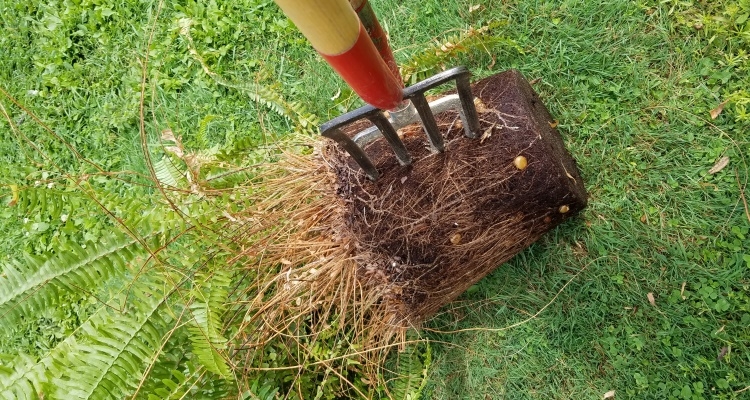
Boston fern (Nephrolepis exaltata ‘Bostoniensis’ and related cultivars) can be propagated by division or runners. Spring is a practical time to divide an overcrowded plant.
- Remove the plant and locate distinct crowns in the dense root mass.
- Use your hands, two forks, or a clean knife to create a few substantial sections.
- Keep a healthy crown, live roots, and sound fronds on each section where possible.
- Repot at the previous depth, water thoroughly, and place in bright indirect light.
For a runner, pin its plantlet onto moist medium in a nearby pot. Sever the connection only after the plantlet has its own roots and active growth. See the Boston fern care guide for ongoing care.
Different propagation methods
Ferns That Should Not Be Split Like an Ordinary Root Ball
Single-crown rosette ferns
Do not cut one bird’s nest fern crown into wedges. Divide only clearly independent offsets when species-specific guidance supports it; spores or tissue culture are often used instead.
Staghorn ferns
Separate a pup only when it has roots and both sterile shield fronds and fertile fronds. This is pup separation, not ordinary pot division.
Tree ferns
Never split the trunk or central crown. Some produce removable offsets; others are propagated from spores. This is specialized work.
Several maidenhair species, including Adiantum raddianum, can be divided, but each section still needs roots and active growth. Review maidenhair fern care before disturbing a stressed plant.
Recovery framework
Aftercare for Newly Divided Ferns
Limit water loss
Use bright indirect light or light shade, protect from wind, and keep the medium evenly moist rather than saturated. Give tropical ferns suitable humidity with air movement.
Keep conditions stable
Water according to moisture, empty saucers, and remove only dead fronds. Do not repeatedly unpot the fern. Delay fertilizer while damaged roots recover.
Return gradually to normal care
Restore the species’ usual light gradually. Resume light feeding only during active growth and when appropriate for the fern and potting mix.
Watering After Division
Water thoroughly once to settle the medium. Then judge moisture by touch, pot weight, and drainage. A small division in a large pot stays wet longer than the former crowded fern. See how often to water a fern for adjustments by pot, season, humidity, and species.
Light and Humidity During Recovery
Recently disturbed roots replace water less efficiently, so use gentler light during early recovery. Stable humidity helps tropical ferns, but sealed, stagnant conditions can favor rot. Combine humidity with drainage and air circulation.
Avoid preventable losses
Common Mistakes
- Cutting equal wedges: one piece may have no crown or bud.
- Making tiny divisions: small pieces have fewer roots and reserves.
- Burying crowns or surface rhizomes: restore the original level.
- Dividing a sick plant: diagnose rot, pests, or stress first.
- Using dirty or dull tools: avoid crushed tissue and disease transfer.
- Moving directly into strong sun: disturbed roots lose water balance easily.
- Overpotting, overwatering, or feeding immediately: let roots recover first.
Diagnosis after division
Troubleshooting
| Symptom | Likely issue | Response |
|---|---|---|
| Wilting fronds | Root disturbance, dryness, sun, or wind | Check moisture and move to protected indirect light |
| Brown tips | Uneven moisture, low humidity, root injury, salts, or light change | Stabilize care and postpone fertilizer |
| Soft, sour-smelling crown | Rot and excessive moisture | Isolate, reduce saturation, and remove rot with sanitized tools |
| No new growth | Dormancy, low light, cool conditions, or no viable bud | Check the growth point and care; do not expect a fixed recovery date |
| Plant rocks in the pot | Poor root contact or oversized container | Firm gently and support temporarily if needed |
Frequently asked questions
FAQ
Can I split a fern in half with a knife?
Only when each half retains a viable crown or growth point and healthy roots. Do not cut through a single crown simply to make two pieces.
Should I cut off all the fronds first?
Not routinely. Remove dead or badly damaged fronds. Healthy foliage helps power recovery.
How small can a division be?
There is no universal size. It needs the correct growing structure and enough roots; larger divisions are usually more forgiving.
Can I divide ferns in fall?
Yes in suitable climates when heat has eased and roots have time to establish before hard cold. Spring is safer in short-season climates.
Why is there no new growth?
The plant may be establishing, dormant, cool, or short of light, or the section may lack a viable bud. Check the crown, planting depth, and moisture.
When can I fertilize?
Wait for active new growth, then follow species-specific guidance and account for nutrients already in fresh mix.
Research basis
Sources Used
- Royal Horticultural Society — How to Grow Ferns
- Royal Horticultural Society — How to Grow Epiphytic Ferns
- Royal Horticultural Society — How to Grow Tree Ferns
- University of Wisconsin Extension — Boston Fern
- Texas A&M AgriLife — Boston Fern
- Iowa State University Extension — Growing Ferns
- University of Minnesota Extension — Clean and Disinfect Gardening Tools
- University of Wisconsin Extension — Staghorn Fern
- NC State Extension — Adiantum raddianum
- University of Georgia Extension — Growing Ferns
- University of Connecticut — Growing Indoor Ferns
- Brooklyn Botanic Garden — Growing Ferns from Spores
- Royal Horticultural Society — Asplenium nidus
- University of Florida IFAS — Asplenium nidus