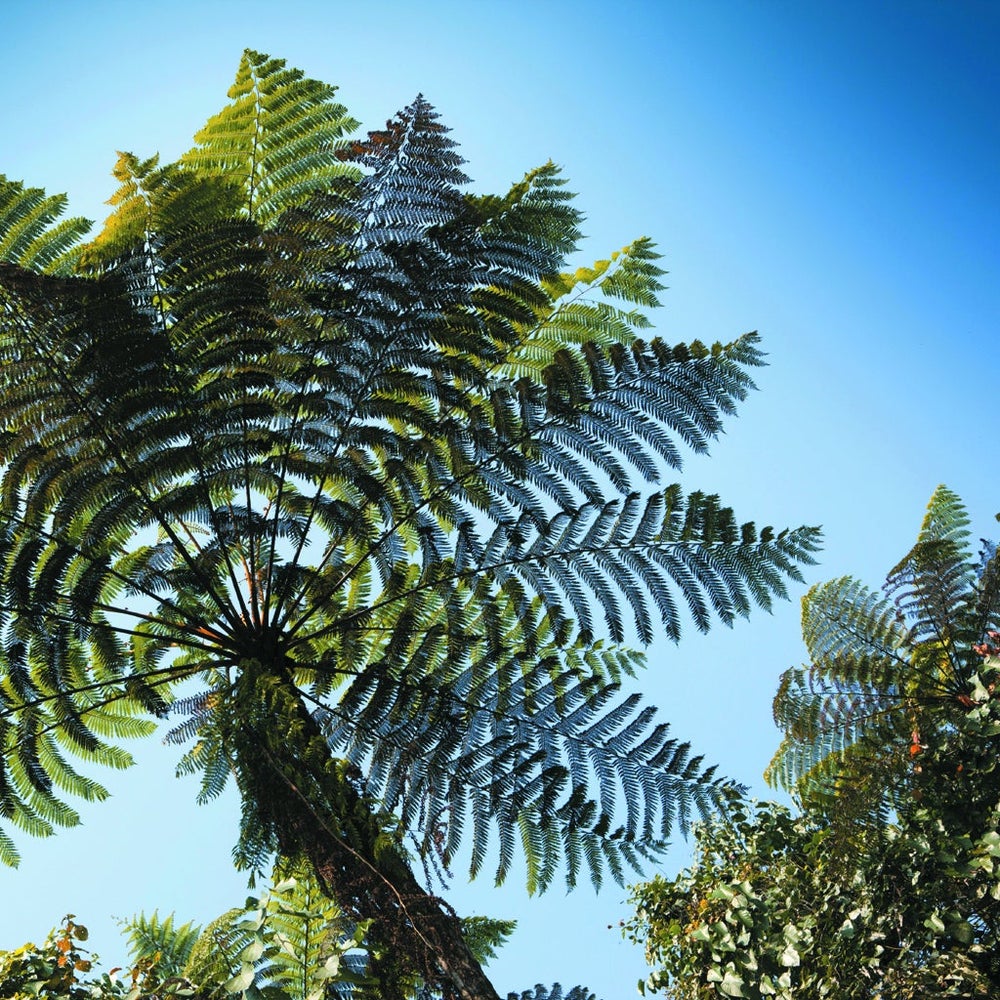
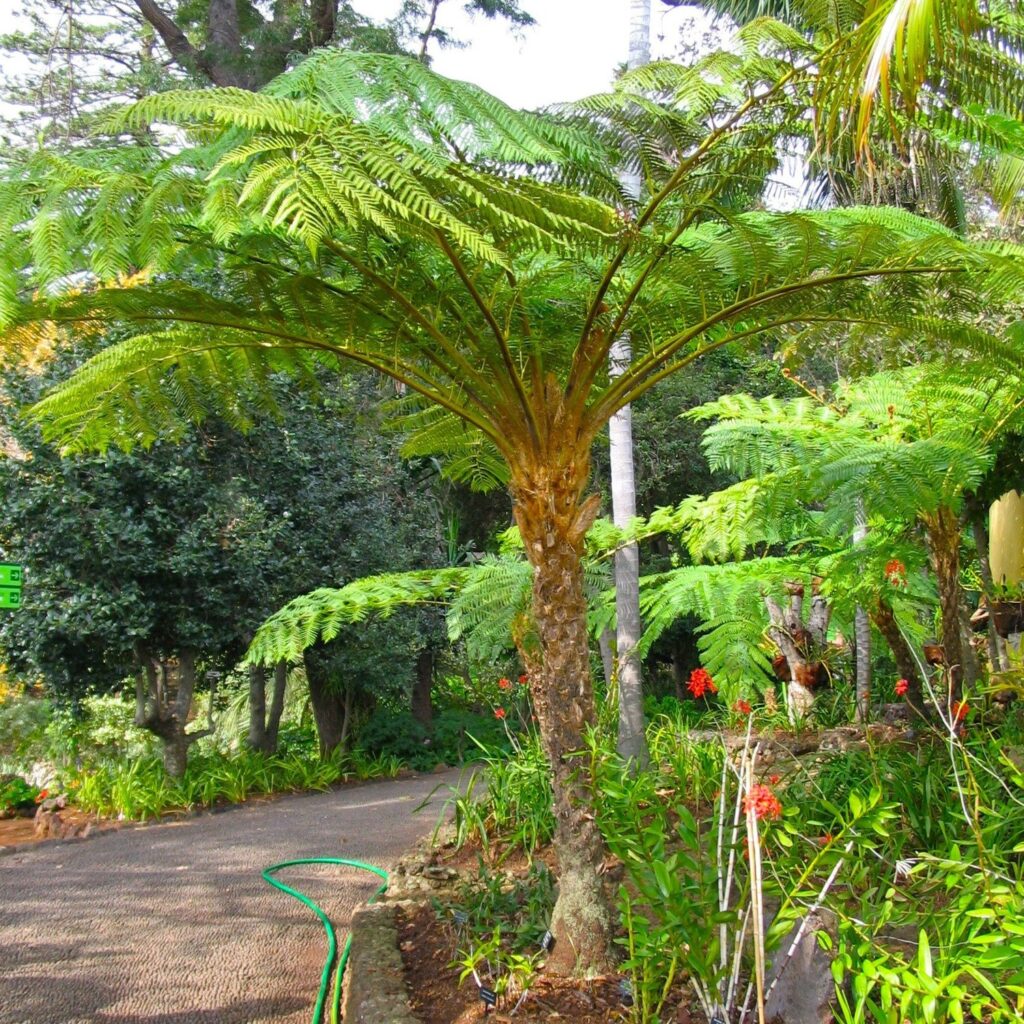
Despite its common name, the Australian tree fern (Cyathea cooperi) is, in habit and stature, more arboreal than fern-like. Distinguished by its finely divided, lace-like fronds and a trunk cloaked in fibrous scales, this evergreen species lends an unmistakably exotic character to cultivated landscapes. It is best established in early spring, flourishing in consistently warm conditions under partial shade throughout the year.
Certain members of the genus Cyathea rank among the tallest of all tree ferns. Within their native Australian habitats, they may attain heights of up to 50 feet. Such dimensions render them impractical for most indoor settings, save for expansive conservatories or greenhouses. Under favourable conditions, they may extend their height by an additional one to two feet annually.
Tree. Ferns. This is literally what it sounds like: ferns of insanely large proportions growing up out of a wood “trunk”. Now I may live in the PNW and be blessed with giant ferns around me at all times, especially when I go hiking in the Cascades, but tree ferns are another level. Indoors these friends get 5-10 feet tall with fronds of 6 feet wide but in the wild they can reach heights of 40+ feet while coming from a variety of climates all over the world.
So why do you need them in your house? Well you are probably already obsessed with the beautiful look and feel of fern fronds, but this is a way to bring in a statement plant that is rarely seen indoors. Tree Ferns are a unique way to create that jungle feel in your house. My guide will cover some of the most popular types of tree ferns along with tips for care and success.
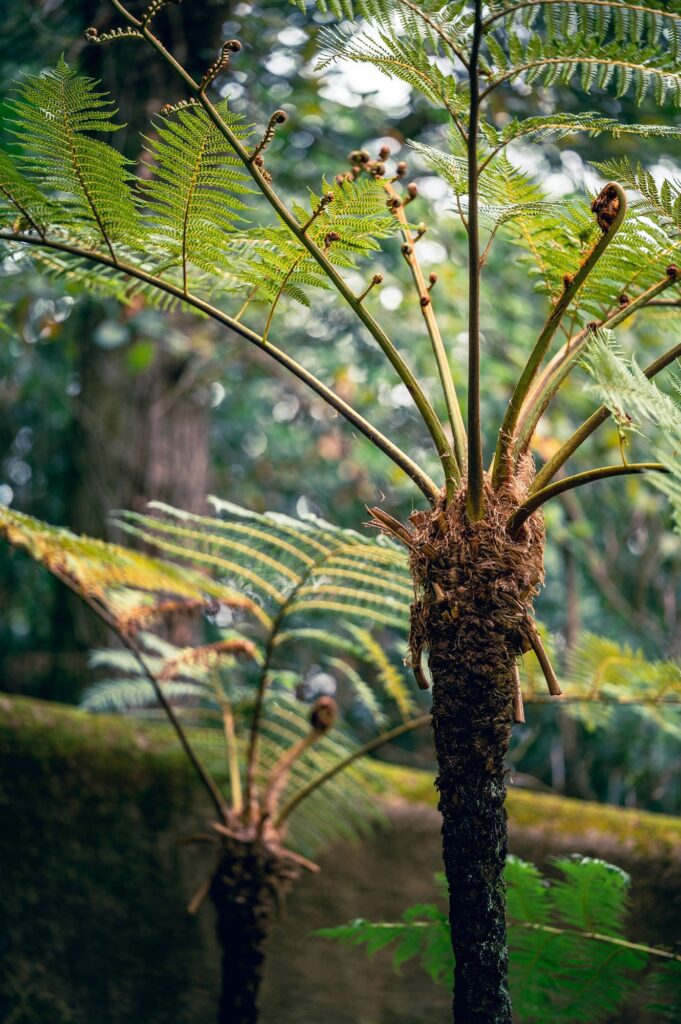
The species has become naturalized in regions such as Hawaii, where its rapid growth and prolific reproduction via spores have led to its classification as invasive.
Australian Tree Fern Care
For optimal growth, situate Australian tree ferns in well-drained soil within a location that receives abundant, yet filtered, light. In cooler climates, container-grown specimens should be relocated indoors during winter. Successful cultivation hinges upon providing dappled sunlight or shade, sustained atmospheric humidity, and consistently moist soil.
Planting
Select a site offering partial or dappled sunlight, with protection from the intensity of midday exposure. Early spring is the ideal planting period, enabling the plant to establish swiftly as daylight hours increase. Prepare a planting hole twice the diameter of the root ball, position the fern carefully, backfill with soil, and water thoroughly to settle.
Light
Although generally adapted to shaded environments, Australian tree ferns can also prosper in locations receiving partial or filtered sunlight, ideally accumulating around six hours of light daily. Increased exposure to direct sunlight necessitates a corresponding increase in watering to prevent desiccation.
Soil
These ferns exhibit tolerance across a range of soil types, including sandy, loamy, and clay substrates. Nevertheless, they perform best in a moist, humus-rich loam that is both fertile and well-draining, with a neutral to slightly acidic pH. The application of mulch is highly beneficial, enriching the soil while conserving moisture, particularly during periods of elevated temperature.
Water
Maintain consistently moist soil conditions, as Australian tree ferns exhibit little tolerance for drought. Weekly watering is generally sufficient, though during periods of extreme dryness, heightened attention to both soil moisture and ambient humidity is essential. Avoid direct watering of the crown to prevent rot; instead, irrigate around the trunk and ensure even soil moisture.
Temperature and Humidity
A stable environment characterized by warmth and humidity is essential, with optimal temperatures ranging between 65 and 80°F (18–27°C). These ferns are sensitive to abrupt fluctuations in temperature or humidity, which may result in browning of the fronds. In cooler regions, cultivation in containers allows for seasonal relocation indoors as temperatures decline.
Fertilizer
During the active growing season, apply a liquid fertilizer monthly. Larger specimens may exhibit greater nutritional demands and benefit from biweekly feeding throughout the year. Always adhere to the manufacturer’s recommendations regarding application rates.
Types of Australian Tree Ferns
Approximately 1,000 species of tree ferns occur across tropical and subtropical regions.
‘Brentwood’ is a notably vigorous cultivar, exhibiting more rapid growth and producing larger, deeper green fronds than the typical species.
The New Zealand or Tasmanian tree fern (Dicksonia antarctica), though closely related, differs in possessing a more compact crown, while sharing broadly similar cultural requirements.
Propagation of Australian Tree Fern
Like all ferns, Australian tree ferns reproduce via spores rather than seeds, and cannot be propagated through cuttings. Spore propagation may be undertaken as follows:
Collect spores from a mature frond onto a sheet of paper.
Sterilize a soilless potting medium by pouring boiling water over it in a heatproof container, thereby eliminating potential pathogens that could impede germination. Allow the medium to drain and cool completely before transferring it to a small pot.
Evenly distribute the spores across the surface and cover with a plastic dome or bag to maintain humidity.
Place the container in a location with stable temperatures of approximately 68°F (20°C) and indirect light.
Maintain constant moisture; germination typically occurs within two to six weeks.
How to Care for the Tree Fern
SOIL: Ferns like soil that is rich in organic matter. I would recommend mixing your own soil for them with 2 parts regular house plant soil, 1 part peat moss, and 1 part sand. This helps insure the soil won’t remain waterlogged but still be nutritious.
LIGHT: Fern’s like indirect light as they are used to having the sun filtered by the plants above but tree ferns prefer a little brighter light then your typical fern. This will help insure that they grow to their large sizes. Place them near a northern or eastern window but if it is western or southern, make sure you have curtains to filter the light or place it out of direct light.
WATER: While each fern is different, keeping the soil from fully drying out is important. Ferns live in wet climates (hello rainforests). When the top inch of the soil feels dry, water again.
HUMIDITY: Similar to their smaller fern cousins, tree ferns love humidity. Remember that these beauties come from tropical climates where the humidity feels like you are breathing water and it rains often. Regularly mist or even place it in humid rooms like bathrooms, laundry rooms and kitchens. For assistance I recommend a continous mister or a humidifier.
TEMPERATURE: Try to avoid drafts. Don’t place your tree fern near an open window in winter or an AC vent or a burning radiator. Fern’s like consistency in temperature and if this isn’t given to them, they will get angry, turn brown and drop leaves.
GROWTH: As your tree fern grows, the lower leaves may start to die back and it is okay to cut these off. Since this will evolve into a tree, the trunk will start to become more apparent as these lower leaves disappear and it grows.
Potting and Repotting
Container-grown specimens should be repotted annually into progressively larger vessels with fresh substrate. Given their susceptibility to root rot, ensure that containers provide ample drainage. Plastic pots are generally preferable, as they retain moisture more effectively than clay.
Once the plant attains the maximum size permissible within its environment, cease repotting to moderate further growth. Ultimately, the fern may outgrow both its container and available space.
Overwintering
The Australian tree fern exhibits moderate resilience, tolerating occasional winter lows of approximately 20°F (-6°C). Where possible, plant near structures that offer protection from strong winds.
In container cultivation, roots are particularly vulnerable to cold due to reduced insulation. Wrapping pots with insulating materials such as bubble wrap can provide additional protection. During winter, avoid watering the crown to prevent decay.
Common Pests and Diseases
Although generally robust, Australian tree ferns may occasionally be affected by mites or mealybugs. Initial treatment involves dislodging pests with a strong stream of water; if necessary, follow with applications of neem oil or an appropriate insecticide until the infestation is resolved.
FAQ
Are Australian tree ferns fast-growing?
In their natural habitat, Australian tree ferns are among the most rapidly growing of all tree ferns. While container-grown specimens exhibit somewhat reduced vigour, they remain relatively fast-growing, with annual increases of up to three feet.
Do they prefer sun or shade?
They perform best under partial sun or dappled shade. Full, unfiltered sunlight should be avoided, as should deep, persistent shade. An ideal position offers intermittent sunlight while shielding the plant from the intensity of midday rays.
How long do they live?
In the wild, Australian tree ferns may persist for nearly two centuries. Under cultivation, however, their lifespan is typically considerably shorter.
Complete guide to tree fern care
Tree ferns are a popular choice for gardeners looking to create a tropical feel in their outdoor spaces. They are slow-growing and can live for many years with proper care. Here is a complete guide to caring for tree ferns:
- Choose a shady spot that gets some gentle sun
- Water when the top two inches of soil feel dry
- Shelter your tree fern from strong winds
- Protect your tree fern from frost and snow
About tree ferns
Tam, our tree fern, is also known as a dicksonia antarctica. Despite the chilly botanical name, tree ferns are native to Australia and New Zealand. They’ve been around a while; in fact, the fossil history of Tam dates back 250 million years, which is 50 million years before the beginning of the Jurassic Period. Pretty cool.
What’s the best location for my tree fern?
Tree ferns prefer shade and gentle sun, so it’s best to place them in a spot that gets partial shade throughout the day. Bright, intense sun will scorch their leaves.
Given their Australian origins they are not fond of high winds and cold temperatures so keep yours in a sheltered spot and either protect it’s crown (the brown hairy bit that the fronds/leaves grow from) with horticultural fleece, or move it under cover over winter (remember to keep it watered if you this though).
What’s the best soil for my tree fern?
Tree ferns need a well-draining, slightly acidic soil with a pH between 5.5 and 6.5. You can keep your tree fern in its pot, or plant it in the ground.
How often should I water my tree fern?
Water your tree ferns regularly, keeping the soil moist but not soggy. They won’t enjoy being left to dry out, so water more frequently in summer or when its warm.
Should I fertilise my tree fern?
Fertilise your tree ferns every two weeks in spring and summer with a balanced, water-soluble fertiliser. This will encourage healthy growth.
Do I need to prune my tree fern?
Prune your tree ferns to keep them healthy and encourage new growth. Snip off any dead or dying branches to keep them neat and tidy.
Common tree fern pests
Look out for pests like mealybugs, aphids, and scale. Treat any infestations as soon as possible.
Should I be mulching my tree fern?
Add a layer of mulch around the base of your tree ferns to help retain moisture in the soil.
Tree ferns are a beautiful addition to any outdoor space, and with proper care, they can last for many years. Follow these tips to keep your tree ferns healthy and happy!