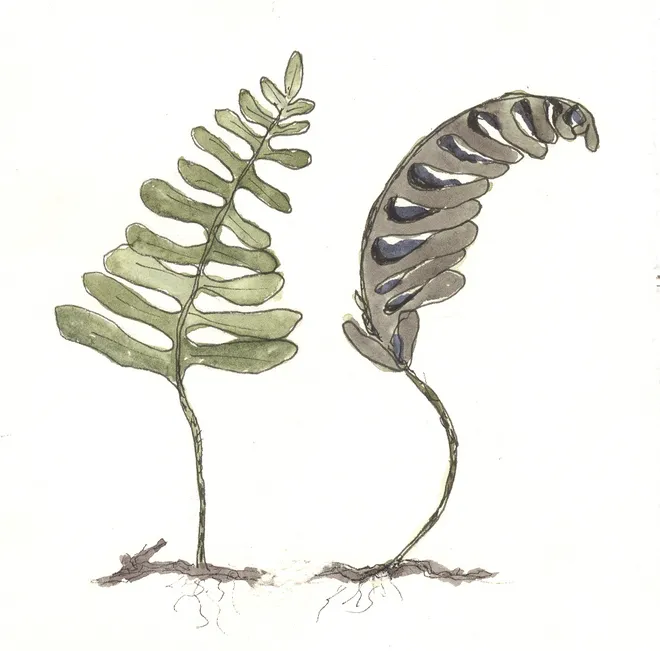
Staghorn ferns are a group of about 18 species of epiphytic ferns in the genus Platycerium of the polypod family (Polypodiaceae) native primarily to Africa, Australia and Southeast Asia, whose fronds supposedly resemble the forked antlers of male deer or elk.
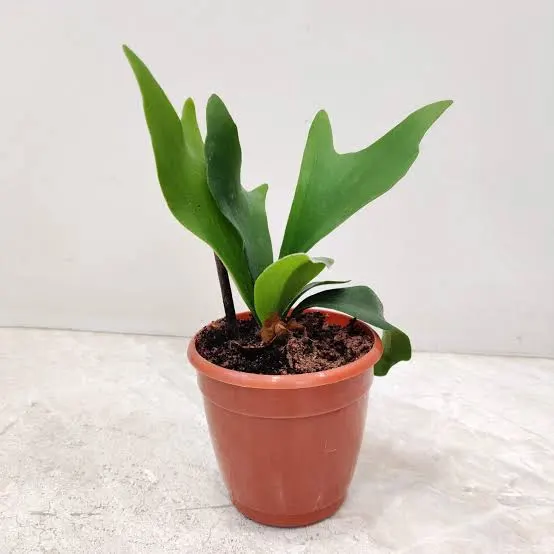
The names “staghorn fern” and “elkhorn fern” are often used interchangeably, although those with thinner fronds are often called elkhorn ferns.P. bifurcatum is the species most commonly cultivated as an ornamental plant, since it is probably the easiest to grow. Native to rainforests of Java, New Guinea and southeastern Australia, it does best with year-round temperatures above 40°F, so it can only be grown in gardens with a very mild climate (zones 9 and above) or as a house plant that can be moved outdoors during the summer. It has naturalized in Florida and Hawaii, where it is considered an invasive species on the islands. Staghorn fern makes a great ornamental adornment for a wall indoors or seasonally outdoors in the Midwest.
| Common Name | Staghorn fern, elkhorn fern |
| Botanical Name | Platycerium bifurcatum |
| Family | Polypodiaceae |
| Plant Type | Fern |
| Mature Size | 2–3 ft. tall, 2–3 ft. wide |
| Sun Exposure | Partial |
| Soil Type | Acidic |
| Hardiness Zones | 9–12 (USDA) |
| Native Area | Asia, Australia |
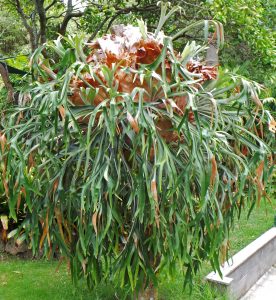
A mature P. bifurcatum can be as big as 3 feet across. The plant grows from short rhizomes that produce two types of fronds. The sterile (non-reproductive) basal fronds are the rounded to heart-shaped, overlapping, clasping, shield-like structures at the base of the fern (sometimes called the back plates). Initially dull green and succulent, they become papery tan to cinnamon-brown with age. They are flattened against the tree to protect the rhizome and tufted roots that grow from it and collect detritus that can provide nutrients for the plant. The fertile (reproductive) or foliar fronds are the brighter green, forked, strap-shaped portions most people would consider the “leaves” growing up from the base. These irregularly lobed, arching fronds grow up to 18 inches long. Each frond branches into two or three segments a number of times along its length. Spores are produced in sporangia in the dark brownish masses (sori) on the underside of the tips of these fertile fronds. Each plant is really a collection of many offsets (called suckers or pups) crammed together and will continue to grow new plantlets as the rhizomes expand out and produce new sterile fronds.
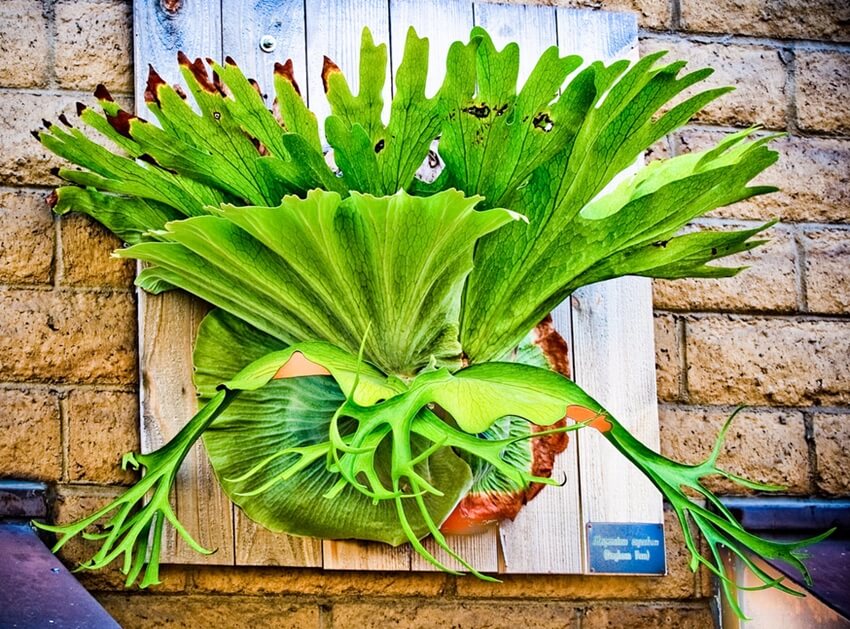
All species of staghorn fern bear both basal and foliar fronds; yet the dimensions, breadth, and degree of segmentation of the fertile fronds vary markedly among taxa. These fertile fronds may ascend with architectural poise or cascade in pendulous grace. In certain species, the basal fronds rise to form a cup-like “nest” that captures falling organic detritus, while the shields created by their overlapping layers range in form from softly rounded to reniform. Other species persist as solitary individuals, producing no offsets.
As epiphytes, staghorn ferns do not inhabit soil but instead anchor themselves to arboreal substrates in their native environments. Juvenile specimens may be cultivated in containers using a rich, freely draining medium; however, under indoor conditions they are most often displayed mounted upon wooden boards, bark slabs, wire baskets, or analogous supports. Such arrangements ensure optimal drainage and facilitate horticultural management, while simultaneously accentuating the plant’s sculptural elegance more effectively than container culture. A modest substrate—commonly sphagnum or peat moss—is provided to receive the roots emerging from the basal fronds. The plant is affixed to its support with monofilament line, wire, plastic mesh, or similar materials, carefully secured over the desiccated, shield-like basal fronds rather than the tender green tissues, which would otherwise be irreparably damaged. As successive basal fronds develop, they gradually envelop and conceal these fastening materials.
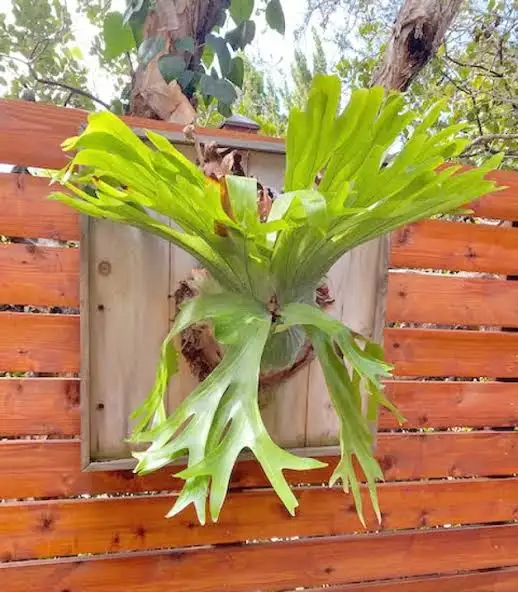
These tropical organisms require ample air circulation, bright yet diffused illumination, warm temperatures, moderate humidity, and a steady supply of moisture. Staghorn ferns absorb water through both fronds and roots; thus, irrigation should thoroughly moisten the basal fronds and the surrounding medium. The substrate should be permitted to dry slightly between waterings, as excessive moisture readily induces rot. Rainwater is preferable where available. Once established, plants exhibit a notable tolerance to drought and may endure extended intervals without irrigation. Moisture demands increase during the summer growing season and diminish under cooler conditions. While capable of tolerating stronger light when humidity and temperature are elevated, such exposure correspondingly increases their water requirements.
Optimal growth occurs under typical household temperatures exceeding 55°F. Specimens maintained indoors may be relocated outdoors during the growing season once nocturnal temperatures consistently remain in the 40s°F, provided they are gradually acclimated to higher प्रकाश levels. Although staghorn ferns can withstand brief exposures to freezing temperatures in the mid-20s°F, it is prudent to return them indoors before autumn nights fall into the 40s°F. During the warmer months, plants benefit from monthly applications of a balanced, diluted liquid fertilizer or from slow-release granules incorporated into the growing medium. Maintaining adequate humidity indoors may prove challenging and often necessitates frequent misting under arid conditions. Where light and air circulation are suitable, bathrooms offer an ideal microclimate due to their intermittent humidity. Staghorn ferns are relatively untroubled by pests but may occasionally harbor scale insects or mealybugs. The tan or brown, shield-like basal fronds should not be removed, even when they appear senescent, as they continue to anchor and protect the plant. Likewise, the fine, whitish-grey indumentum on the fertile fronds—responsible for their dusted appearance—should remain undisturbed, as it serves to reduce transpiration. Desiccated fertile fronds, however, may be judiciously pruned.
As with all ferns, these plants exhibit an alternation of generations, comprising the diploid sporophyte—the familiar fern—and the haploid gametophyte. Spores produced by the mature plant germinate into diminutive, often overlooked gametophytes: delicate, heart- or kidney-shaped structures, typically a single cell layer thick and lacking differentiated roots, stems, or leaves. These bear both male and female reproductive organs, which mature asynchronously to promote cross-fertilization. Motile sperm, equipped with flagella, traverse aqueous films to reach eggs housed within flask-shaped archegonia on neighboring gametophytes. Following fertilization, the resulting zygote develops into a new sporophyte.
Propagation from spores is possible but protracted; consequently, staghorn ferns are more commonly propagated by division. Offsets are carefully excised with a sharp blade, ensuring that each division retains both fertile and sterile fronds as well as viable roots. Newly separated plants should be maintained under warm, humid conditions until firmly established—a process that may require considerable time.
A number of additional staghorn fern species are available through specialist growers for collectors, many presenting greater horticultural challenges than P. bifurcatum.
P. andinum is the sole representative native to the New World. Originating from the seasonally dry forests along the Amazonian slopes of the Andes in Peru, it produces loosely overlapping sterile fronds that form a flared, crown-like shield, accompanied by remarkably elongated, narrowly segmented, and prominently veined fertile fronds that hang in verdant ribbons exceeding five feet in length.
P. coronarium, indigenous to Southeast Asia and the East Indies, bears broad sterile fronds and slender, pendulous, forked fertile fronds that may extend up to fifteen feet.
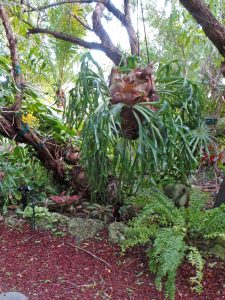
P. grande is a solitary species distinguished by upright, fan-shaped sterile fronds forming a nest up to four feet across, and by large, drooping, strap-like, unbranched fertile fronds reaching six feet in length.
P. hillii produces bright green fertile fronds of comparatively modest length—two to three feet—while both sterile and fertile fronds are notably broader, with pronounced bifurcations.
P. superbum, native to Australia, forms an upright assemblage of wide, bifurcating sterile fronds that create a capacious “nest,” capturing leaf litter and organic debris that decompose into nutrient-rich humus. Its broad, branching fertile fronds cascade two to three feet beneath the plant’s core. Naturalized populations in Hawaii are now regarded as problematic. This species is sensitive to extremes of cold, heat, and excessive moisture, and, being non-offsetting, must be propagated exclusively from spores.
P. veitchii is more diminutive and slow-growing than P. bifurcatum, bearing softly pubescent, blue-green fronds and exhibiting a greater tolerance for direct sunlight.
The fronds possess a coriaceous texture and are cloaked in a delicate, felt-like indumentum of pale, hair-like trichomes, an adaptation integral to the interception and retention of atmospheric moisture. When this protective layer is abraded, the fronds are prone to desiccation, browning, and eventual collapse. The spores, suffused with a warm cinnamon hue, are borne upon the abaxial surfaces of the bifurcating frond apices.
These ferns exhibit a dimorphic frond architecture: a basal, orbicular shield that appears to secure the plant to its arboreal substrate, and a series of elongate, branching fronds that extend outward from the host surface. With maturation, successive generations of fronds accumulate in superimposed layers, the newer enveloping the senescent, papery predecessors to form a cylindrical structure. This natural receptacle captures water and organic debris, which gradually decomposes into a nutrient-rich humus that sustains the plant.
Staghorn ferns flourish in luminous, well-ventilated environments, yet they are intolerant of both direct solar irradiation and profound shade. Established specimens should be irrigated only when the fronds begin to exhibit slight wilting or loss of turgor; excessive moisture invariably predisposes them to rot. The basal fronds, though often superficially dry, retain substantial reserves of water within their spongiform tissues. If gentle الضغط upon these brown shields yields moisture, irrigation is unnecessary.
Many commonly cultivated species produce adventitious offsets, or “pups,” which may be detached to propagate new individuals. Larger offsets possess a correspondingly higher probability of successful establishment. Separation is achieved by excising the pup from beneath its basal fronds, occasionally incorporating a portion of the parent’s basal tissue to obtain a segment approximately one inch thick. A pad of moss, one to two inches in depth, is affixed to the reverse of the division, which is then mounted upon a suitable support—such as a wooden board or driftwood—and secured with wire or strips of plastic.
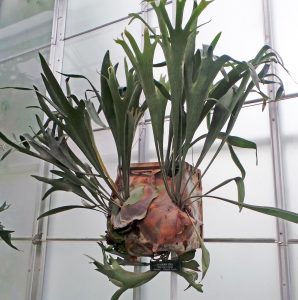
Staghorn fern (Platycerium spp.)
An essential consideration in assessing a plant’s compatibility with a domestic environment, and in anticipating its cultural requirements, is an understanding of its ecological provenance. Species indigenous to arid landscapes demand abundant प्रकाश and sharply draining substrates, whereas those originating from rainforest understories require protection from intense light and benefit from elevated humidity.
Members of the genus Platycerium are epiphytic ferns native to tropical rainforests. They inhabit the upper strata of the forest canopy, where their roots derive nourishment from organic matter accumulated in the शाखा crotches they occupy. They produce two distinct frond types: sterile basal fronds, which typically age to a brown hue and form overlapping layers that clasp the substrate, and fertile fronds, which are conspicuous, green, flattened, and evocative of stag antlers in form.
Staghorn ferns are visually arresting organisms capable of imparting a striking architectural presence within interior spaces. Given their potential to attain considerable dimensions—often reaching three to four feet in height—they require ample სივრც to accommodate their growth.
Light:
In contrast to many forest-dwelling plants, staghorn ferns occupy elevated canopy positions and are thus adapted to relatively მაღალი light intensities. They perform optimally under bright, indirect illumination.
Water and Humidity:
Originating in humid rainforest ecosystems, these ferns favor consistently moist conditions. The compost or moss substrate should remain evenly damp during the active growing season, and merely moist during periods of reduced growth. Water uptake occurs both through the fronds and the root zone; accordingly, both misting and thorough soaking are recommended for optimal hydration.
When the sterile fronds fully envelop the growing medium, irrigation is best achieved by immersing the basal portion of the plant in water until saturation is complete. The plant should then be allowed to drain thoroughly before being returned to its display position. Watering frequency should be reduced in winter, when physiological uptake slows.
Temperature:
Platycerium species tolerate temperatures up to 75°F, though an optimal range centers around 70°F, with a minimum threshold near 55°F. They favor airy, well-ventilated interiors; in warmer conditions, daily misting may be required to maintain adequate humidity.
Re-potting and Mounting:
Staghorn ferns may be cultivated in free-draining compost, mounted upon boards, or suspended within hanging baskets, with the latter methods generally preferred. For mounted culture, the plant is established in sphagnum moss and secured to a suitably sized piece of wood or bark using wire or fishing line. In hanging baskets, a lining of sphagnum moss supports the plant until the expanding basal fronds envelop the structure. These approaches replicate the aerated conditions characteristic of their natural epiphytic habitat.
Nutrition:
During periods of active growth, occasional applications of diluted liquid fertilizer are beneficial. Mounted specimens may be nourished by immersing the supporting material in a dilute nutrient solution.
Observational Considerations:
Direct exposure of fronds to intense sunlight may result in photobleaching and the formation of irregular blemishes. Optimal development is often enhanced by a nocturnal temperature reduction of approximately ten degrees.
Both excessive and insufficient watering can prove detrimental; attentive calibration of irrigation and misting regimes is therefore essential. Although generally resilient, these ferns may occasionally be afflicted by scale insects, particularly on the undersides of the fronds.
Staghorn Fern Collection
We invite you to explore our curated assemblage of staghorn ferns—plants of remarkable form and presence, whose sculptural elegance has long captivated enthusiasts.
Staghorn ferns, also known as elkhorn ferns, belong to the genus Platycerium. As epiphytes, they are not dependent upon soil for growth; rather, their roots have evolved to anchor them to ծառ trunks or other संरचनाएँ, without extracting nutrients parasitically. Instead, they subsist upon organic debris—fallen leaves and detritus—that accumulates within the basin formed by their basal fronds.
Native to tropical and subtropical regions of the Southern Hemisphere, Platycerium species are distinguished by their antler-like fertile fronds and protective shield fronds. They prosper in environments ranging from temperate to humid and are particularly well suited to mounted displays that echo their natural growth habit upon trees.
Requiring relatively modest care, these ferns are favored by indoor horticulturists seeking to introduce a bold, sculptural dimension to their plant collections. Their distinctive morphology ensures that they command attention, whether displayed upon walls or suspended in baskets.
For those embarking upon cultivation, Platycerium superbum offers an excellent introduction. More experienced growers may wish to consult comprehensive care guides to further refine their horticultural practice.